Subscribe to Feed            Add to your Favourites

“It suddenly struck me that that tiny pea, pretty and blue, was the Earth. I put up my thumb and shut one eye, and my thumb blotted out the planet Earth. I didn't feel like a giant. I felt very, very small.” – Neil Armstrong (1930-2012)

Fresh Reads from the Science 'o sphere!

Showing posts with label chinese. Show all posts

Thursday, December 30, 2010

林湘萍 (Yvonne Lim) vs 陈邦鋆 (Andie Chen)

I can't be the first person on the planet to have noticed this...


The resemblance is uncanny.

That. Same. Smile.


From the side, there are some differences.

Andie clearly has a more angular jaw and broader chin, but MAN... the positions of the eyebrows, eyes, nose and mouth are spot on.

Did I mention that Yvonne Lim was a Star Search '97 finalist while Andie Chen was the '07 winner?

Or that both of them are Poly grads (albeit Yvonne was in SP while Andie was in NP)?

Oooh scary!


It's the exact same smile I tell you... the way the smile line extends straight below the edges of the mouth.


As you can see, other facial features are pretty similar too.

I guess it doesn't help my case to point out that at 1.83 m tall, Andie is a towering 21 cm taller than Yvonne.


Though you don't have to be Jedi Twins to have the same smile.


Would you like to know more?

- Andie Chen's photos

Monday, December 08, 2008

The Meanings Of Life

On the 12th of December 1936, almost 72 years ago, Generalissimo Chiang Kai-shek, leader of China and the Nationalist forces, was kidnapped by his former ally Marshal Zhang Xueliang, in a pivotal event which will later be known as the Xi An Incident.

Here's a quick historical background behind the event:

Although on paper the Republic of China was established in 1912, in practical terms there was limited central control and various parts of China were ruled by a chaotic succession of local warlords.

From 1926 to 1928, Chiang Kai-shek led the Northern Expedition, supported by an uneasy alliance of Nationalist and Communist forces, in order to eliminate the warlords and unify China under the Nationalist flag.

He succeeded in this quest and became the first (and till date, the only) leader of the unified Republic. However, his hunger for military power during the Expedition, in particular his brutal attempt to purge Communists from his party, had also won him a powerful new enemy - the Communist Party of China.

Meanwhile, with an effective central government finally in place, the next ten years was marked by rapid economic and industrial progress, and this period in China's history (1928-1937) is often dubbed “黄金十年” (the Golden Decade).

Even during the golden decade, Chiang Kai-shek had two major worries - the Communists and the Japanese. The Japanese had invaded Manchuria in 1931 and appeared poised for further military attacks.

Chiang considered defeating the Communists as the higher priority, since they threatened the unity of his fragile Republic.

Moreover, China was still a poor country and he hoped to buy more time to build up a modern military force that can counter Japanese aggression. For example, he had begun to equip the military with a large number of German-designed weapons and Chinese soldiers were starting to be trained by advisors from Nazi Germany (history is so strange... the Tripartite Pact was not signed until 1940)!

Unfortunately, this incremental approach was deeply unpopular among the people, who were far more alarmed by the increasing belligerence of the Japanese and demanded immediate retaliation.

This resulted in the Xi An Incident.

Backed by popular sentiment, Zhang Xueliang and collaborator General Yang Hucheng, who were previously Chiang supporters, captured Chiang Kai-shek and forced him to cooperate with the Communists to fight the Japanese. They also contacted the Communist Party and there was widespread pressure to execute Chiang, especially from party leaders such as Mao Zedong, until Stalin (of all people!) intervened in Chiang's favour.

12 days later, Chiang was released, shaken and humiliated.

He realized that if he did not act against the Japanese immediately, he would soon be killed by his own people. He could not hold back any longer.

Half a year later, the Marco Polo Bridge Incident finally sparked off the long and bloody Second Sino-Japanese War (1937-1945).

And because the people could not wait, they now had to fight the machine guns, artillery and tanks of the Japanese with sabres and outdated rifles, in a lopsided war of attrition that would leave tens of millions of Chinese dead and the Nationalist government lethally wounded.

After the war, the Communist Party became the dominant military and political force and took over the leadership of mainland China. The defeated Chiang Kai-shek was left stranded on Taiwan yearning for a day when he can return and reunify China again under the Nationalist flag.

It was not to be.

**********

Wow, that was like the longest preamble ever!

You are thinking: "I see that Fresh Brainz has somehow become a history blog. BYE dude."

Wait a sec! Let me explain.

That was an illustration about the meanings of life.

No, no that Monty Python movie - "meanings" is plural, see?

Actually I won't be discussing the whole philosophy behind the meaning of life; instead, I would like to focus on a specific issue:

Is there only ONE set of meanings that applies to ALL aspects of life?

A few weeks ago, there was a commenter on YouTube who felt that if there was no supernatural source for the meaning of life, then life would only be about "propagating your DNA".

Of course, many people will instantly protest that there are many other potential, non-supernatural meanings of life aside from DNA replication.

But I would take a different approach.

Let's check if propagating DNA is the only purpose of life.

My first question would be: "Whose DNA?"

For a single-celled organism, the answer is easy: the DNA of the entire individual.

Unfortunately, multicellularity has turned complex organisms like plants and animals into very strange systems indeed.

Due to DNA copying error during cell division, every cell in the body of a complex organism has a unique sequence.

However, only a minority of cells (germline) in the organism is directly involved in reproduction. These are the only cells that have the "privilege" of passing their DNA down to the next generation.

All other cells will die along with the whole system, including another powerful minority group that controls much of the whole individual's behaviour - the brain cells.

So, does that mean that only germ cells can possibly have any meaning in their lives?

That the rest of our bodies cannot possibly have any meaning because they do not propagate DNA?

At minimum, the individual needs to have some meaning until reproductive age before the germ cells have any chance to fulfill their meaning. More strikingly, if the individual only loses reproductive ability (ouch!) the other cells continue functioning and the whole individual doesn't immediately die.

Germ cells may be in a hurry to pass their DNA to the next generation, but brain cells and other body cells clearly have other priorities.

Just consider these points:

- How much time do you spend eating, drinking, talking, thinking, sleeping, crapping and browsing the Intertubes in comparison to the time you spend on full sex?

- Why didn't you immediately mate with the nearest member of the other sex the moment you reached reproductive age?

- If you are ordered to mate with somebody you utterly hate, not only will you refuse it, you might even kill yourself to avoid it. Why such reluctance to fulfill your life's "meaning"?

- If propagating your DNA was the only meaning in life, how can people voluntarily use contraceptives, including rhythm method? In fact, how could anyone possibly come up with the idea of contraception?

At the societal level, it is convenient to consider individuals simply as functional units, but an individual is actually made up of numerous subsystems with their own goals and "meanings", not all of which are aligned with the goals of other subsystems or the emergent goal of the entire organism.

We are quite familiar with situations where there are conflicts of interest between the subsystems and the whole individual:

- Cancer

- Autoimmune disorder

- Chronic pain

- Suicide

- Risky behaviour of adolescents (eg. deaths due to stunts performed to impress women)

Propagating DNA is just one aspect of the living experience - it cannot be the only meaning of life.

I would argue that aside from the tendency of living systems to try to survive longer, there is no specific set of meanings that would be relevant to ALL aspects of life.

Even at the societal level, what one culture has cast in stone as the absolute meaning of life is regarded by other cultures as meaningless or irrelevant.

I also feel that there is an interesting similarity between the tug-of-war of goals between the subsystems of an organism and subsystems of a society.

That is the reason why I started this post with a brief discussion of modern Chinese history.

If we consider the citizens of China as the "body" of the State, we can see that their primary concern is the survival of the entire State, which was threatened by Japanese military expansion.

If we consider the leadership of China as the subset "brain" of the State, we can see that:

- Chiang Kai-shek and other Nationalist leaders are also concerned with the survival of the State, but they considered their Nationalist government to be integral to the unity of the State. Thus they focused on the survival of their government by trying to eliminate the Communists first and by ignoring Japanese transgressions until the government is sufficiently equipped.

- Mao Zedong and other Communists leaders are also concerned with the survival of the State, but they consider the indecisive behaviour of the government against the increasingly audacious Japanese military as a major threat to the State. They intend to replace this government one day with their own party, so they are not concerned if the current government is unprepared to fight the Japanese. People who are a danger to their party, such Chiang, should be eliminated.

The State has a goal.

The constituent subsystems also have goals that appear to be broadly aligned with that of the State, but when you look at the details, you can find some conflicts of interest because the primary goal of each subsystem is its own survival.

Things could turn out very wrong.

If Chiang Kai-shek was allowed to continue delaying the war with the Japanese, he would be able to buy a few more years of stability for his government, but by then it might be too late. The Imperial Japanese Army could have become strong enough to invade China and destroy both the mutually weakened Nationalists and Communists.

If Mao Zedong had successfully executed Chiang, it is possible that the Nationalist government would have a leadership vacuum and political infighting would return. This ineffective government would then be forced to enter a war with Japan with neither a strong military leader nor modern armaments. It could then be easily defeated by the Japanese, who would settle back into a long term occupation of the mainland, destroying the Communists at their leisure.

Complex systems are made up of parts that have different purposes or "meanings". As long as these components have broadly aligned goals, they can form a system together, resulting in a compelling illusion of unity.

For practical reasons, we are accustomed to oversimplify these systems by considering them as whole units.

But subsystem-level analysis can help us understand why people, and indeed "whole" societies, can do the strangest things.

Friday, November 14, 2008

Lost In Translation: Music Video From 1976

A nice song from a generation ago which could do with a better English translation that preserves the poetic devices in the lyrics (especially personification) ...


Here's my take:

我是天空里一片云,
偶尔投影在你的波心。
你不必讶异,无需欢喜,
在转瞬间消灭了踪影。

I am a cloud in the sky,
Occasionally reflected in the heart of your waters.
You shouldn't be alarmed, needn't be elated,
For in the blink of an eye all trace of me will vanish.

你我相逢在黑夜的海上,
你有你的,我有我的方向。
你记得也好,最好你忘掉,
在这交会时互放的光亮。

You and I meet in a dark night on the sea.
You have yours, I have my own direction.
Good if you remember, but best if you forget,
The brilliance we unleashed in this encounter.

It's a pity they don't write lyrics like this anymore.

I prefer my love songs to have a touch of tragic.

Tuesday, April 29, 2008

Perils Of Being Moderate

It's common shorthand these days, especially for mainstream new agencies, to label people who don't have strong opinions as "moderates".

I think this is a misnomer that confuses the vast majority of the people who are simply apathetic and don't care either way, with individuals who have deeply considered the topic and genuinely hold a moderate stand.

And the way that "moderate" is used also gives a false impression of safety - I mean, if a person holds such a reasonable stand, embraced by the majority and buffered away from all those "extremists" in society, who would ever want to attack her?

A good question.


On the 7th of April, Chinese Paralympic fencer Jin Jing (金晶), who was one of the Olympic torchbearers during the relay in Paris, was attacked by pro-Tibet protestors attempting to wrestle the torch away from her.

Her steadfast protection of the Olympic torch against the unruly demonstrators initially turned her into a celebrated hero in China. In addition, many Chinese citizens were enraged by the incident and blamed the French government for allowing it to happen.

As the sentiments continued to rise, numerous Chinese citizens decided to boycott the French retailer Carrefour as a show of anger towards France.

Jin Jing appealed to the crowds to be prudent in handling calls to boycott Carrefour. She felt that the first victims of such a boycott are likely to be the many Chinese employees at Carrefour.

This is a clearly a moderate stand, coming from the victim of the attack herself.

The response?

Many Chinese netizens immediately called her a traitor and launched a barrage of personal insults at her. The respect and admiration for her quickly transformed into frenzied rage against her.

Jin Jing is not the only person to be facing fierce attacks for her moderate stand. Grace Wang (Wang Qianyuan 王千源), a student at Duke University who tried to encourage dialogue between pro-Tibet protesters and pro-China protestors, was also branded as a traitor.

Her predicament is even worse - she needs police protection at Duke, and her family in China had to go into hiding because they received death threats.

It's not easy to be a moderate, because you can end up being shot by both sides.

Sometimes the most vicious attacks may actually come from "your side".

There are many tragic examples in history.

On 4th November 1995, Yitzhak Rabin, the first native-born Prime Minister of Israel, was assassinated.

He was shot, not by a Palestinian, but by a right-wing Orthodox Jew.

Rabin had been deeply involved in the Middle East peace process, resulting in the Oslo Accords in 1993. For his efforts, he was awarded the Nobel Peace Prize in 1994.

However, many right-wing Israelis considered him to be a traitor for giving away land that rightfully belongs to Israel. The Oslo Accords caused deep divisions in Israeli society, ultimately culminating in the fatal shooting.

Prominent individuals often get singled out as targets for extremists of both sides, but sometimes there is no safety in numbers.

Even a large group of people can become victims.

During the Rwandan Genocide of 1994, Hutu militia groups planned a large-scale murder of the Tutsi minority in their country. However, the first people to be targeted in the mass killings were in fact a number of moderate Hutu politicians.

Members of their "own side".

They were silenced because they could help stem the fever pitch of anti-Tutsi sentiments that had rapidly escalated in Rwanda. Without their voices of reason, the Hutu militia could then play up the pent-up emotions of huge crowds of Hutus and incite them to violence.

Thousands of Hutus, along with about 800,000 Tutsis, perished during the genocide.

So you can see that being "moderate" is not some lazy, default state that people lapse into when they don't give a shit about anything.

I would argue that very few people have the courage to maintain a moderate stand when huge adversarial groups of people face off against each other. When you are neither "us" nor "them", you become "them" to both sides. Dichotomies, even false dichotomies, have immense social power.

Much easier to adopt an extreme stand and enjoy the absolute solidarity and power that it provides.

There aren't many genuine moderates in society, but without them, peace is very difficult to achieve.

Sunday, January 13, 2008

Fact vs Theory

Just installed a new, easy-to-use Chinese input tool from Google. I haven't written a Chinese article for a long time, so here's a bilingual post for your reading pleasure. My apologies for awkward or inaccurate technical terms in Chinese; feel free to correct them in the comments section.

Fact versus Theory

Most people are too busy making a living to care about science. For them, science is a subject they learnt in secondary school that made them do gobs of meaningless calculations and memorize a ton of facts. Thus it is hardly surprising that they consider "fact" as the central essence of science. Facts appear to be solid, concrete things - permanent and dependable.

In contrast, the term "theory" is commonly used to describe a hunch, or at best an educated guess. Speculative and full of uncertainty. It isn't helpful that academic scientists use "theory" for something totally different - a highly-ranked class of solidly supported ideas that is far from speculative. This schism in semantics has been shrewdly capitalized during the Creation vs Evolution culture wars in the USA to portray evolutionary theory as an iffy conjecture.

Some people have proposed changing the term "theory" to "fact" to emphasize the certainty of biological evolution. While there are many facts that support it, evolutionary theory itself is not a fact, it is an explanation of facts. Thus I feel that switching these terms will simply cause more confusion.

Besides, by doing this they are reinforcing the public perception that facts are somehow more important than theories in science.

Are facts important? Of course! Without facts, the scientific endeavour would not be rooted in reality. Facts on their own constitute a significant compendium of human knowledge. In addition, you need accurate facts to help test and build a flourishing theory, or to help dismantle a failing theory.

Are theories important? Without a doubt! If not for theories, science would simply drown in an ocean of unconnected, isolated facts. Theories provide explanations for natural phenomena, and demonstrate meaningful relationships between the plethora of discovered facts. This allows us to apply our knowledge to other relevant scenarios and create new technologies. In addition, you need dependable theories to help check the reliability of the facts and guard against exaggeration or deliberate fraud.

So which one is the most important concept in science?

Actually, it is neither.

To me, the most important concept in science is the testable prediction.

Equipped with supporting evidence from facts and a explanatory framework from theories, we can then proceed to make precise, daring predictions.

Will there be an annular solar eclipse on the 7th of February, 2008 at 0355hrs Universal Time, most clearly visible from 67.6S latitude and 150.5W longitude? Will it last exactly 2 minutes and 12 seconds?

Will average density of the planetary bodies in our solar system decrease as their distances from the Sun increase? Will all the major bodies revolve around the Sun in the same direction?

Will there be a fossil that looks like a transition between a fish and an amphibian buried in a sedimentary rock layer that is 375 million years old?

Will homologous organisms, determined by comparative anatomy, also have highly similar genomic DNA sequences? Will closely-related species share evidence of viral infections that afflicted their last common ancestor?

The ability to generate precise, testable predictions and then trump them is the most impressive achievement of science. Toward this purpose, facts and theories are of equal weight - neither should be considered as mere conjecture or permanently cast in stone.

Thus, creationist and intelligent design "theories" that seek to deny many previously accumulated facts, do not provide a better explanation than existing theories, and do not or cannot in principle have any testable predictions - have no ability to generate any new knowledge. They are not scientific theories at all, not even hypotheses.

They are superstitions.

资料与理论

处在忙碌的生活里,多数人对于科学的兴趣不大。 对他们来说,科学是当年在中小学时读的一项科目,挤满了毫无意义的算术和堆积如山的事实资料。应此,人们难免会把“资料”当成科学的中心点。资料是固定的,可靠的。

相反的,“理论”在许多人的心目中只不过是一种悬空,暂时性的猜测。可惜科学家对于“理论”的用法持有天渊之别。唯有经历过严格实验证实的构思才能称得上是理论。在美国,这运用上的差异早已成为神创论者用来抨击演化论的工具。

为了强调演化论的实际性,有些学者认为演化的理论应该改称为一种“资料”。但是理论不是一种资料,它是一种解说大自然现况的方法。

对于科学来说, 到底是资料还是理论扮演比较重要的角色?

资料很重要吗? 当然! 没有资料的科学是不踏实的。玲琅满目的资料是人类整体智慧不可缺少的一部分。有了准确的资料,才能建立或反驳各种科学理论。

理论很重要吗? 毫无疑问! 没有理论的科学只能淹没在林玲种种的个例当中。理论把这些资料拼凑成一幅有意义的画。 有了明确的理论,科技才能迅速发展,而新发现的资料也能受到严格的评估,以防诈骗。

资料与理论各有千秋,但对我来说,科学最重要的力量,就是非常详细的推测。有了资料和理论并肩的支持,科学家能够做大胆的推测,有待实验证实。

下一次的日食会不会在2008年2月7日,UT凌晨3点55分发生? 日食会不会持续2分钟12秒?

太阳系里的行星平均浓度是不是越远离太阳越低? 该物体的轨道有没有一致的方向?

一个体型在于鱼类跟两栖动物之间的化石会不会出土? 它是不是埋在3亿7千5百万年前的石层里面?

体型接近的生物会不会也有类似的基因组脱氧核糖核酸次序?有共同祖先的生物有没有古代遗留下来的病菌踪迹?

准确的推测,是科学最令人叹为观止的成就。资料和理论的贡献不相上下, 也不容忽视。

相比之下,神创“论” 不理会大量的事实资料, 不比现有的演化论含有更高的解说价值,而且不能提供有意义的推测。一个不能测试的“理论”,连假定都不是。

它其实是一种迷信。

StumbleUpon Toolbar Stumble It!

Monday, December 10, 2007

Just Keep Walking On

I wrote a song!



When the path feels too rough
When the road seems too long

When voices that surround you scream on night and day

When your load is much too heavy
When your burden's hard to bear

When your legs beneath you are almost giving way

When the pain is far too deep
When the tears have run dry

When the fire inside you has turned into dismay

Why don't you...

Put your left foot over your right foot and keep walking on

Don't lose hope, all hope is gone
There's a pretty sunset waiting just ahead
Why care about the circling vultures up above your head?

请把脚尖贴着脚跟继续向前行
莫心慌, 莫彷徨

希望早已过去梦想已成空
何必在意遍地毒蛇缓缓的行踪?

Just put your right foot over your left and keep staggering on
Toe to heel, heel to toe
The sun will soon be setting and the night shall fall
Why care about the hungry wolves that wait for us all?

For it soon will pass, and this song will end
Its echoes in the mountains will be all that remain
The game has long been fixed, we will never win
Can you hear the thunderous silence of a cry in vain?

Don't stop, just...


Put your left foot over your right and keep struggling on
One more step, just one more step
The darkness will soon descend the madness it will start
Why care about the coldness reaching into your heart?

One more step, just one more step

Just one more step.


Heh, it's a Monday.

Sunday, November 04, 2007

Three-Layered Science Communication

I just finished grading over 680 undergraduate lab assignments (whew!) and while most students know generally what was going on during the training lab, the style of their writing isn't easy to read.

Mangled sentence structure is rather common, and there is quite a bit of repetition and beating around the bush, which I guess is to be expected in this sort of assignment.

Only a handful of students wrote clearly and succinctly, quickly showing me that they really understood the experiment. A few of them even drew illustrative analogies to help explain the experiment in a more visual way.

It's impossible to conclude anything from an undergrad assignment, but I get a sense that there won't be many people who know what is going on in a technical field and can communicate it clearly to lay people.

Science communication is an integral aspect of the science endeavour in developed nations because many of them have such a long scientific tradition that it has become part of their culture. In Singapore however, the scientific endeavour is very young, and the feedback that I get from talking to some members of the public isn't encouraging.

They don't know what is going on, nor do they care. That's sad because some of this knowledge will have direct impact on their lives. They are missing out on some really cool stories about how the Universe works, or how the world of science works.

Even from a super pragmatic point of view, scientific insight can help give them a leg up against their competitors.

So, how to bring science from laboratories and conference rooms into kopi-tiams (coffeeshops)?


Fresh Brainz will use the animated movie Ice Age (2002) to illustrate our three-layered approach in science communication to capture the public's attention and still provide accurate specialist insights with minimal exaggeration and hype.

Don't worry if you haven't seen the movie - there won't be any spoilers below.

(But you should watch it because Disney sucks and Dreamworks rulez.)

1. Lowest common denominator

The Ice Age movie is meant for both kids and adults.

Kids love it because there is a lot of slapstick comedy between Manny the Mammoth, Sid the Sloth and Diego the Sabretooth tiger.

Not to forget the random antics of the cute and blindingly stupid Scrat!


Even if they are too young to understand the story, wacky physical humour captures their attention and provides enjoyment.

This lowest common denominator transcends age and cultural barriers - the main reason why Rowan Atkinson's retarded Mr. Bean series is far more popular worldwide than his brilliant Blackadder series.

For maximum accessibility, Fresh Brainz is written in plain, grade school English with minimal technical jargon. Slapstick humour and stupid jokes are part of the writing style.

Our lowest common denominator also includes: sex and schadenfreude.

Wait... I can turn this into a slogan.

Science - because that's what I like to write!

Sex - because that's what you like to read!

... and Schadenfreude - because that's the most genuine kind of joy (since it doesn't include even a drop of envy)!

A staple of gossipy Chinese evening newspapers and tabloids, sex and schadenfreude have been capturing the attention of the masses since time immemorial.

Here at Fresh Brainz, we are loathe to tinker with this proven relic of negative selection pressures.

2. Coherent narrative

The basic story of Ice Age is simple - a ragtag group of animals migrating south for the winter, chance upon a human baby.

They don't like each other and may in fact be dangerous to each other. Despite the initial distrust, they slowly become friends and set off to return the baby to the human tribe.

Scientific discoveries and technological innovations don't always lend themselves to good storytelling. Some scientific issues are multi-faceted, theories are not mutually exclusive and experimental data can swing either way. The emergence of new technologies are similarly mired in complexity.

However, no matter how complicated the issue is, to avoid throwing gobs of facts and figures that sound meaningless to the regular reader (or even experts in other fields), a coherent narrative structure is a must.

Prudent simplification is the key.

The story should not attempt to present all the confusing aspects of a scientific topic - just one or two main ideas with clearly explained background, developing gradually using relevant facts and illustrations with intensifying rhythmic intensity until finally... a climax is reached.

Any complications should be then be noted and references provided for people who wish to go into more details.

Complications tend to appear after the climax. It's just in the natural order of things.

3. Insider jokes

Despite the deceptively simple main story of Ice Age, the entire movie is peppered with naughty language and insider references that only an adult (and a well-read one at that) can appreciate.

Not limited to jokes, there is a particularly emotional scene in the film when Manny relives a moment of tragedy and inner conflict.

Kids won't understand it, but adults will cry buckets.

These references don't appear often and even if you don't understand them, it won't affect the story.

Nonetheless, it's a *wink* to those in the know.

In the case of science communication, insider references are essential.

Experts quickly see pass the two layers of attention-grabbing shtick and simplistic storyline to find the details that they want - the significance and novelty of the scientific finding, as well as links to the original study.

In addition they are also soundly entertained by exclusive jokes that make them laugh like the squeal of a CO2 incubator on a weekend.

Insider reference is the highest (or narrowest?) layer of science communication that should be used sparingly, since it's really disturbing to see people winking at each other all the time.

----------

So there you have it, Fresh Brainz's very own three-layered style of science communication, freshly baked to perfection with a mountain of whipped cream and a perky strawberry on top.

Will people eat it up? Or will they lick the cream off and leave the cake untouched?

Ok I'll leave you to enjoy that mental picture.

Mmm strawberry...

Wednesday, August 29, 2007

Latest News: Coco Liu Enters Showbiz!

OMFG.

Just last month, Fresh Brainz featured the infamous stripper-cum-blogger Coco Liu Yao.

She was accidentally thrust into the limelight when Hong Kong media mogul Chu Pui-Hing was spotted by photojournalists while they were walking towards her apartment.

Mr. Chu ducked behind Coco and ran away from the reporters, eventually hiding in a toilet. Unfortunately he was recognized from the photos and became a tabloid sensation. The entire debacle forced Mr. Chu to cut short his career.

Coco, in contrast, went from strength to strength. Her previously obscure blog was swamped by over 100,000 readers a day.

After lying low in her hometown of Sichuan for a short while, Coco went to Beijing and was talent spotted by internet film director Xu Jing (徐兢).


He reportedly offered her a 10 million yuan (S$ 2 million) contract to shoot a film exposé of the nightclub scene in Hong Kong.

Two million dollars !?!!

Exit Coco Liu the Stripper.

Enter Coco Liu, the Blogebrity-Superstar-Sex Goddess.

She now goes by Erotic Lady Coco (艳女郎COCO) and has a couple of new blogs showcasing even more sexy photos while wearing very little clothing.

Here's one of her blogs...


... and here's another.


As you can see, many of her new photos are taken by professional studios. They are not only tasteful but also artistically done.

Coco must be the envy of her ex-colleagues!

Which is why she has stopped contacting her friends in Hong Kong. She believes that they will betray her confidence for the sake of money.

Heh, Coco is a smart girl.

But we already knew that.

In addition to shooting sexy photos, Coco is now busy with many showbiz commitments: appearing at store openings, giving media interviews, preparing to release a music single - even becoming a judge of a new reality show in China!

Indeed, she is well on her way to become a superstar in Beijing.

Wait a minute...

Oh NO!!!

Won't that put her on a collision course with another superstar in Beijing - Crystal Liu Yi Fei (刘亦菲)?


Coincidentally, they have the same surname.

And they are both 20 years old.

But that's all they have in common, I'm afraid.

Crystal Liu graduated from the prestigious Beijing Film Academy in 2006. She started her TV career in 2002 and shot to fame when she played the role of the Little Dragon Lady (Xiao Long Nu - 小龙女) in CCTV's 2005 drama series - Return of the Condor Heroes.


And she's no slouch on the big screen neither - Crystal Liu made her first movie in 2003. She is also making a foray into the music industry by signing a recording contract with Sony Music in 2005.

Delicate, angelic and innocent-looking, Crystal Liu is almost the antithesis of Coco Liu.


What will eventually happen in this Superstar Kumite of megalithic proportions?

Who will eventually prevail?

Nobody knows.

Personally, I only know one thing for sure.


I didn't make this poster.

Honest.

Sunday, July 22, 2007

Stripper, Blogebrity or Systems Engineer?

This woman is now the hottest blogger in Hong Kong.

Her blog is read by over 100,000 people a day.

And she hasn't even updated it since January.

Of course you are asking: WHY?!!


She is Louis Vuitton Yumiko, who also goes by Coco (because she looks like popstar Coco Lee) - a buxomly 20-year-old nightclub hostess involved in a sex scandal three weeks ago.

Her real name is Liu Yao. She used to work in a karaoke club called "Must Kara" at Causeway Bay in Hong Kong, where she would don wigs and perform striptease dances for wealthy clients.

Then on the 5th of July, an embarrassing accident happened.

Chu Pui-Hing, Director of Broadcasting at Radio Television Hong Kong, visited the Must Kara club with his friends.

He is married with two kids.

At the club, Mr. Chu was so enamored of Coco that he

... repeated praisedly (sic) her beauty and kept his hands on her breast.

He paid thousands of dollars for Coco to perform an exotic dance with her brunette wig.

Impressed, he then paid thousands more to take her out.

As they were walking towards Coco's apartment, the media chief was suddenly spotted by a group of reporters who were covering Kenny Bee's concert nearby.

The photographers went into immediate action.

And this is the result.


Mr. Chu ducked for cover behind Coco, still hanging on to her wig. Meanwhile Coco appeared pleasantly surprised in all the photos, probably because she had no idea who Mr. Chu was.

He later ran away and hid in the toilet of a restaurant.

But it was too late.

He had been recognized and his photos splashed all over the tabloids.

Because of the media fallout from this debacle, Mr. Chu resigned from his post, ten months ahead of his planned retirement.

His career was over.

Coco, on the other hand, immediately shot to fame. Her blog, which includes some photos of her wearing tantalizingly little, is swarmed by a few hundred thousand readers within days.

She is currently lying low in her hometown of Sichuan, China to avoid unwanted attention. But she still hopes to return to Hong Kong and become a top Mama-san someday.

You are thinking: "Now just wait a minute... Why are you featuring this piece of schadenfreude trash news? Is it merely because Coco is now the top blogger in Hong Kong?"

Not quite.

Fresh Brainz is featuring Coco the stripper/blogebrity extraordinaire because of what she wrote in her blog:


任何一种选择都不可能结局完美,就比如选择了典雅的高根鞋便放弃了舒适的平底鞋. 当香烟爱上火柴..就注定被它伤害..点的是烟..伤的是心!

女人..无所谓正派..正派是因为受到的诱惑不够..

男人..无所谓忠诚..忠诚是因为背叛的筹码不够..

Oops, I forgot that 99% of Fresh Brainz readers don't read Chinese, so here is my (not very arty) translation:

There isn't any one choice that gives a perfect outcome, for instance by choosing elegant high heel shoes one has to give up comfortable flat shoes. When a cigarette falls in love with a match, it is destined to be hurt by it.. what lights up is smoke.. but what hurts is the heart!

Women.. there isn't any so-called decent woman.. she is decent only because she hasn't been tempted enough.

Men.. there isn't any so-called faithful man.. he is faithful only because he doesn't have enough bargaining chips for betrayal.


Her first line sounds strangely familiar!

Just check out this paragraph from a systems engineering website:


What is Systems Engineering?

The word optimal should not appear in the statement of the problem, because there is no single optimal solution to complex systems problems. Most system designs have several performance and cost criteria.

Systems Engineering creates a set of alternative designs that satisfy these performance and cost criteria to varying degrees. Moving from one alternative to another will usually improve at least one criterion and worsen at least one criterion, i.e. there will be trade-offs.

None of the feasible alternatives is likely to optimize all the criteria. Therefore, Systems Engineers must settle for less than optimality.

No complex system is likely to be optimal to all the people, all the time.


So Coco is a stripper/blogebrity/systems engineer?

Oh the humanity!

Heh.


Would you like to know more?
-
RTHK chief quits amid media frenzy

Monday, July 31, 2006

Holiday @ Genting.
Day One - Looking around.


After I checked into my room, I went to the First World Plaza to have a late lunch at Marrybrown's, which serves good chicken burgers. The first thing I noticed was that there were a lot of Middle East and mainland Chinese tourists. There were tour guides leading dozens of eager tourists who were dragging their luggage around.

Wasn't this the "low" season? Maybe only for Singaporean tourists.


When I was done refueling it's time to walk around. This is a panorama of Genting's Outdoor Theme Park, chock full of amusement rides. A place where kids get all excited and scream a lot.


I was more interested in this. A place where adults get all excited and scream a lot. I literally heard one group of punters scream when they were on a winning roll. Most people there were rather quiet though.

There are two main casinos in Genting, a huge one centred on Genting Hotel and a smaller one within the First World Plaza. Each entrance is guarded by two security guys and equipped with a metal detector gate.

No cameras or camera-phones are permitted inside the casinos, sorry guys, no pictures there.


Here's another casino entrance with signs to remind people of the rules and regulations. Dress code is smart casual, but they're really lax about it nowadays. When my parents came here years ago, people were required to wear batik shirts or long-sleeved shirts to enter a casino.

Oh did I mention the sheer number of uncles and aunties inside? It was really packed. Most of the casino customers were middle-aged folks, playing card games and electronic roulette on the tables. A good number were on the slot machines too. The only young people I could see were the casino staff.

How did all these uncles and aunties get so rich? To fritter away their money for hours like that?

Seems like when you're a grad student, everyone is richer than you.


Genting may call itself a City of Entertainment, but it is obvious that gambling is the major part of it. Regular casino-goers apply for a membership card called the Worldcard, which provides incentives and exclusive perks on a cumulative point basis.

The Worldcard can be used for discounts while shopping here, and there is a Genting Rewards shop where members can exchange points for gifts. The goodies don't just end there. In fact the entire Highlands Hotel is members-only. You can see by the ornate entrance of this hotel what a privilege it must feel like to stay there. There is even a VIP reception (up the escalators in the photo) for high-rollers.

I immediately imagined the God of Gamblers played by Chow Yun-Fat (周润发) strolling suavely into the VIP reception with his bowtie and slicked-back hair.

In slow motion.

I watch too many movies.


I think that the casino high-rollers are the most valued guests at Genting. Let me demonstrate that by showing you a comparison between the statues found in the Highlands Hotel and First World Hotel. You don't need to guess which is which. The contrast in quality is striking.


There are a few huge banners advertising the casinos throughout Genting. When I looked at this model I found that she looked somewhat familiar.


Then I saw this wall advert and suddenly realized that - she looks like Anita Yuen (袁咏仪)! Oh my, did Anita become a casino model?


Nope. It's definitely not her, but still quite a resemblance. Maybe she's an evil clone?

I like evil clones.

In addition, these adverts have a strong "Hong Kong" flavour to it, but I can't quite put my finger on it. Despite the large number of Middle East and mainland Chinese tourists passing through, I get a feeling that Genting values Hong Kongers a lot. Sort of like Macau.

So to make Hong Kongers feel right at home, Genting has restaurants with familiar sounding names.


Like "Causeway Bay".


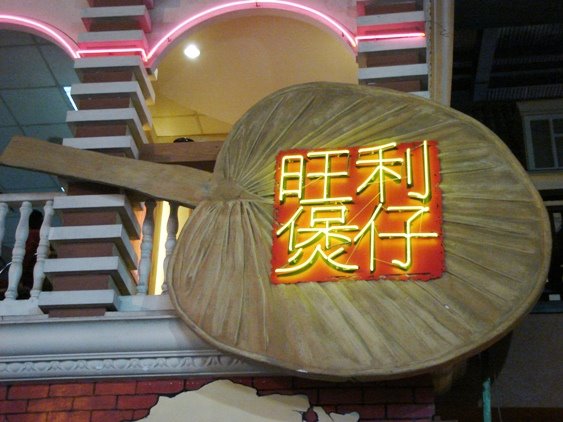
Or a claypot restaurant with distinctly a Cantonese name. Translates literally to "Prosperity Come Claypot Little/Boy."


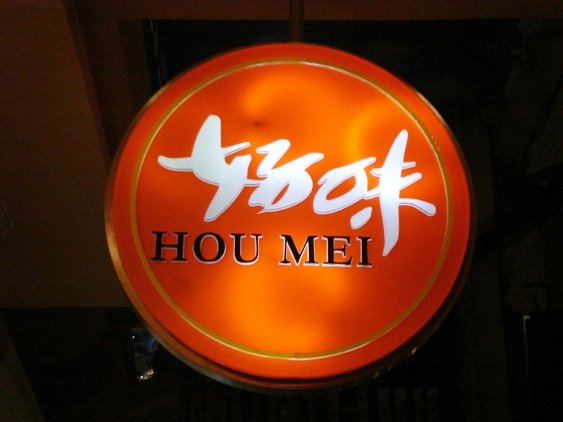
Here's another - "Good Taste", an eatery with Cantonese romanization.

Well who could blame them, everyone knows that Hong Kongers are made of money.

Especially the God of Gamblers, but good luck getting a cent out of that guy.

Saturday, July 22, 2006

博客:网站与作者。

And now, a Fresh Brainz exclusive! I bring to you, dear readers, my first Chinese blog entry! The language may be different, but I insist on maintaining the same fluffy, Fresh Brainz style of prose even for this article. Quality control is very important.

今天让我们来关注一下"博客"这个词。当然,博客是直接从英文的 Blog 以发音翻译过来的,本身没有中文意义, 不过这个用法非常流行, 或许是因为它比输入"网上日记"来得方便吧。但,词内的"客"字可能会产生某些误解。"博客"指的到底是网站还是人?严格说应该是指网站,不过媒体也常用它来形容博客的作者。用"博客主"会比较正确, 但听起来又显得有点别扭-都有个"客"了, 何必多来一个"主"?

在台湾比较普遍的翻译"部落格"虽然长了些, 倒比较明确。"部落格主"啊"部落格主"。说上口了, 听起来象 Blogger Zoo, 还准确地形容博客圈里的实际状况。打个比方,我这个禽兽就是个很好的例子!哈!

再说,对于一向来都不用资讯科技的阿叔阿嫂来言,"博客"听起来很象是在形容常常去赌博的人。


"哎呀!我们家乖儿子刚从同学们那里学会了怎么当那个,那个什么'博客'! 那群损友也太没教养了, 年纪轻轻学人家赌博。该怎么办才好呢?心酸啊!"

提起赌博自己倒觉得有点痒。该是到云顶高原去博一博的时候了。真想念那一排排一望无际的老虎机, 吃钱的时候不吭声,赢钱的时候却"叮叮当当"地响。这可是"鼓励"你继续给它喂钱的有效策略。富有催眠性的音响效果-那是多么迷人啊!

唉, 不跟你多说了,让我先去把床底下的银角通通扫出来。

No, I will not provide an English translation for this.

Go Babelfish it yourself, lazy ass.