Subscribe to Feed            Add to your Favourites

“It suddenly struck me that that tiny pea, pretty and blue, was the Earth. I put up my thumb and shut one eye, and my thumb blotted out the planet Earth. I didn't feel like a giant. I felt very, very small.” – Neil Armstrong (1930-2012)

Fresh Reads from the Science 'o sphere!

Thursday, October 12, 2006

Chad and Steve: Sultans of YouTube

The recent news that Google has bought YouTube for a staggering US$1.6 billion (in stocks, not in cash, but still...) has sent repercussions throughout my lab.

Or is that because we are next to the Neuros construction site?

Anyway as I was saying, the first thought that ran through everyone's mind when the deal was announced is:

Those lucky bastards clever geniuses! Who are these guys anyway?

Here at Fresh Brainz, we immediately set out to learn more about the two newest billionaires on our planet: Chad Hurley and Steve Chen!
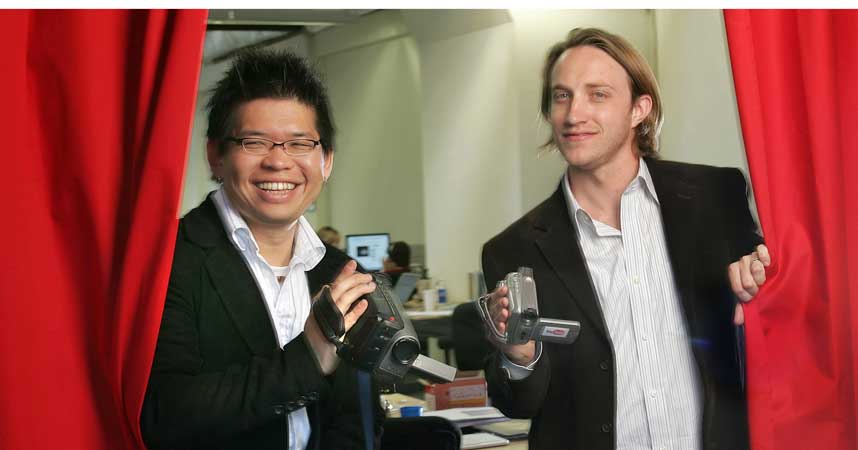
First stop: Wikipedia, why of course.

I searched for Chad Hurley and Steve Chen.

Not much stuff there. After all, they are young guys who were fucking nobodies not so prominent before the deal.

So, in order to dig up interesting information, it's time to crunch through the Deep Web with my teeth.

Grrrrrrrrhhhhh!

Turns out that Chad was trained as a designer while Steve did computer science at the university. Neither of them are drop-outs, so perhaps the glory days of the super drop-outs are now officially over.

Isn't it funny how it's always one pair of them? Usually an arty guy partnered with a geek?

I'm beginning to see a pattern. Hmm...

For more details, here are some articles that I've found. Enjoy!

YouTube (WEB2.Ohhh!)

YouTube: Way Beyond Home Videos (BusinessWeek)

Steve Chen: The Local Boy That Created YouTube (Taipei Times)

Of course, not everyone thinks that the Goo-Tube deal makes business sense.

There are two major concerns - despite its overwhelming popularity YouTube hasn't really made money yet, and there is that nagging problem of copyright infringements.

Check out this blog post by veteran investor Mark Cuban.

I Still Think Google Is Crazy (Blog Maverick)

He also has a few other Youtube-related articles on his site.

If you have no time to read these sources, let me just quote Chad Hurley himself (from the BusinessWeek comments section):

I do not want to work hard. I want to live a soft life. I want to sleep for three hours every afternoon. I do not want to stay awake the whole day so that I can get a few grand at the end of each month. That is why I choose to live off the Net. I am too lazy to try and survive in the real world...

...We worked for about six hours each week for two months designing YouTube. We had the idea to create a community around the video. Once that was done we knew that tons of millions of dollars would just flow into our laps after a buyer which we expect to happen very soon. We will not have to work hard...

...Now we are sitting at home waiting for a buyout. I expect to make at least $400 million personally. Content has been handed to us on a silver platter. We do not have to slog hard to create content like a poorly paid online journalist who makes a lousy $450,000 each year.

Making US$450,000 is poorly paid?

I would be ecstatic if I could even make US$45,000 a year. Graduate school lowers your expectations on just about everything.

Except chocolate. I will NEVER compromise on chocolates.

Tuesday, October 10, 2006

Viva La VivoCity

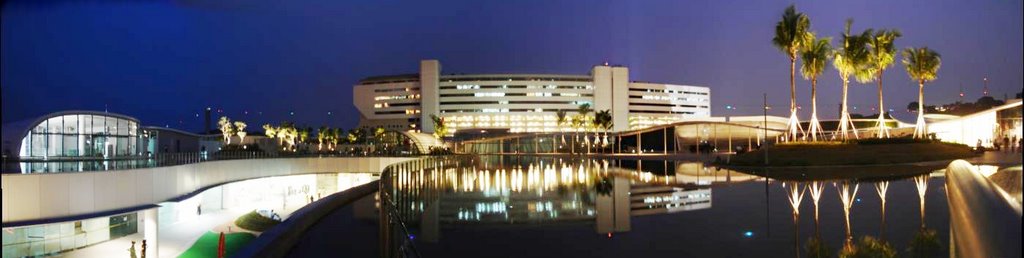
The LARGEST shopping mall in Singapore has just opened! Named VivoCity, it has 1.5 million square feet of gross floor space and has a capacity for 300 shops. Although only 60% of the shops are now open (official opening is in December), Fresh Brainz was there yesterday to take a quick peek at this behemoth.

Whazzah!


New-fangled shopping malls tend to have water features. I'm not much into Feng Shui, but I've noticed that the water features have become more computer-controlled and elaborate over the years. For example, this wall of water jets changes height frequently. Another one inside the mall can produced wave-like patterns.

Perhaps Qi is enhanced by microchips?


Nowadays, architects try to make their designs as organic as possible. To conceal the box-like nature of this shopping mall, they put huge curvy structures on the outside. I understand their importance from a design point of view, but I can also imagine these as a maintenance nightmare in time.


The inside of the mall is also full of curves. I'm not talking about all the hot babes strolling inside. OK maybe I am. But the floor layout is also quite curvy. The centrepiece of the mall is this green triple-helix sculpture lined with blue light.

Oh look! It's a collagen triple-helix! Ooooooooh!

That's just my inner science geek speaking.

Oh did you notice that "VivoCity" has the same meaning as "Biopolis"? Huh? Huh?

Shut up brain! *pokes brainz with an Q-tip*

Mmrrppffff....better.

As for the shops, so far the line-up looks nearly the same as any other major mall, which is rather boring. However there is one important exception.

Gloria Jean's Coffees is back! They have the second best hot chocolate in the world. Tim Horton's has the best, but they are not available here, so I'll go for the second best quite happily.

Also, though many of the eateries are familiar franchises, they are positioned to offer customers a great sea view that other shopping centres cannot provide.

On top of that, VivoCity has a huge roof garden (pun fully intended) complete with an amphitheatre, trees, sculptures and water features. Here, check out the panorama I took:


There is so much space! Ah... you can just lie on the boardwalk, watch the boats in the harbour and enjoy the sea breeze.

This is the best shopping mall ever.

Sunday, October 08, 2006

Irreducible Complexity Pwned

More than two hundred years ago, there was a theologian called William Paley. One day, he looked at a brass watch and thought: "Hmm... brass watches are really complex things, with so many parts that must fit together perfectly in order for them to tell the time properly."

Then, he had a flash of insight: "Hey, living things are complex things too! In comparison to a watch, a human being contains way, way more parts. All these parts must fit together perfectly in order for a person to be alive."

"In fact, living organisms must be separately constructed in their own unique way. Since brass watches are made by smart people, living things must be made by an even smarter 'person', why, this is the ultimate proof of the existence of an intelligent, Designer God!"

Thus, the Watchmaker Analogy was born.

Fifty years later, Charles Darwin came along and proposed that all life on Earth is linked. Modern living organisms are not specially created - they descended from organisms that lived in the past. Over millions of years, descendants of a common ancestor can change so radically that they diverge into different species of living things. This explains the wonderful diversity of life on our planet.

Darwin's idea had been controversial from day one, but today, after almost 150 years of research work by thousands of scientists, from a variety of fields using different approaches, the theory of evolution by natural selection has been validated as scientific fact. Although many details of this process are still unclear (that's where I come in), most scientists agree that evolution itself is strongly supported by evidence.

Of course, there are a few exceptions. In 1996, biochemist Michael Behe published a book called "Darwin's Black Box", where he introduced the concept of irreducible complexity - essentially reviving Paley's argument about a Designer God.

Instead of a brass watch, he used the analogy of a mousetrap. He believed that all the parts of a mousetrap must fit together for it to work properly. He then extends this to the idea that many structures inside the cell are irreducibly complex and must be precisely made by a Designer God.

Unfortunately, he chose a poor analogy. His critics managed to make mousetraps using fewer and fewer parts than he could ever imagine. Worse, they even demonstrated that a complex mousetrap can be modified from simpler "ancestors".

Due to this and many other reasons, irreducible complexity is not a hypothesis that is taken seriously by most scientists. However, opponents of evolution relentlessly repeat this idea as if it is a major blow to evolutionary biology.

Now that I've given you a brief background on this debate, let me tell you what I think.

To be fair to Dr. Behe, neither the brass watch nor the mousetrap are good analogies to living organisms. I'll demonstrate this fact to you, but I won't compare and contrast all the details between single-function machines like the watch and living systems.

Fresh Brainz isn't like those other science blogs!

Instead I will give you a super simple example why irreducible complexity is utter bunk.

Think of a baby. Coochy-cooch-coo!

Babies are complex organisms, yes? They grow and grow. Different parts of the baby grow at different rates. By the time they become adults, the proportion of their body parts have become quite different.

Can a watch grow like this? Nope. If the gears or the brass casing grows proportionally faster, the entire watch fails. Similarly a mousetrap.

Living systems are not rigid like a watch, they are flexible and robust. They have a modular organization, that allows for variation in some parts not to affect the function of other parts. This same feature also permits the organism to evolve. All the parts don't have to be perfect - what about people with extra fingers? Or people with organs on the "wrong" side of the body?

The overall organization is more important than the precise position of every cell in the body. In fact, due to the constant turn-over of cells, you may be a "different" person from year-to-year! In addition, we lose thousands of nerve cells from our brainz everyday. How can we even remember what just happened with so many missing parts?

Where was I?

Oh yes, as I was saying, if a baby was really made up of perfectly-aligned components, then growth would be impossible. Any tiny mis-timing in the growth of one part will cause all the other parts to fail.

A Designer God would have to make a brand new baby every time.

This is what irreducible complexity would predict.

And this is exactly what we don't observe.


To learn more about the evolution of complexity, I recommend "The Plausibility of Life" by Kirschner and Gerhart. It's a bit heavy, but overall an excellent read.

Saturday, October 07, 2006

Interview With A Scientist

It is with great pleasure that I present to you: the first Fresh Brainz interview with a scientist -
Dr. Andrew Thomson.

A real scientist, my friends. Not a wannabe like me.

Andrew did his PhD at Aberdeen University in Scotland. He is legendary for his distinctive chuckle and his upbeat attitude. Did I mention his knack for double-entendre jokes?

I often feel encouraged by his sunny disposition in the lab, so I decided to chit-chat with him to learn more about his secret of happiness!

Unfortunately I caught him in a sleepy mood after lunch, kept barely awake by a large mug of coffee. Will this interview score or end up as a total snore? You'll soon find out!

Me: What was your original reason to do science?

Andrew: It's a long story. As a kid I was always interested in how things work. In high school I never wanted to work in a lab, but that view changed when I learnt more about science at the university. It was either research or forensic biology, and I chose research.

Me: What is your reason for continuing to do science now?

Andrew: Well, that's because it still excites me... despite the politics and massive egos that can get involved. I believe you should be true and honest to your research.

Me: Was there ever a time in your scientific career when your morale was less than zero?

Andrew: Quite a number of times actually... *chuckle* When I was one-and-a-half years into my PhD I asked myself - do I really want to do this? I think you have to see pass that and appreciate the significance of your work. Sometimes your bosses will try to pummel your integrity into the ground. Should you do science to promote yourself as a supreme being? I think that reduces the nobility of the field.

Me: What was the happiest day in your career?

Andrew: A few instances. Six months into my PhD I solved a research problem that an American group couldn't solve for ten years - that gave me no end of great pleasure! *chuckle* I could do it because I came from a different background and used a different approach. My supervisor was not supportive, but I went ahead and published the results. Also, when you see your students start to achieve and push forward their own projects. When they can assess their own results. That gives me the greatest pleasure.

Me: What would be the best place for a conference?

Andrew: Cancun, Mexico. I'm from Jamaica originally, and I think some mountains in Jamaica are also great places for a conference.

Me: And the worst place?

Andrew: New Orleans. I went there once, there was no atmosphere - all hype. The conference building was concrete and foreboding.

Me: I see that you're happy everyday. Do you have any advice for students regarding longevity in doing science?

Andrew: At the end of the day, keep your integrity intact. Try to be positive. Especially a positive attitude with your co-workers. Try not to get bogged down - tomorrow is another day.

Me: Any comfort food? Like chocolates?

Andrew: Not really. I'd just be less likely to eat.

Me: And now for my last question. What is it about Life, the Universe and Everything - excluding 42?

Andrew: I don't know *sneaky voice*... I guess that's why I keep going and stay excited about trying to find out.

Me: Thanks Andrew!

Andrew: That's OK, I needed a break anyway. *chuckle*

Haze Daze

Sigh.

The hazy days are back again with a vengeance.

Every year around this time, illegal land clearing activities in Indonesia lead to raging forest fires that utterly fuck up the air for neighbouring countries like Malaysia and Singapore.

I don't know how many bilateral agreements have been signed regarding this, but the fact remains - we still get burnt, crappy air yearly.

This time though, the air is especially bad. Just check out this morning's pollution index at the National Environment Agency (NEA):


130!?!!

That is well into the "unhealthy" category. I think it hasn't been this bad since 1997.


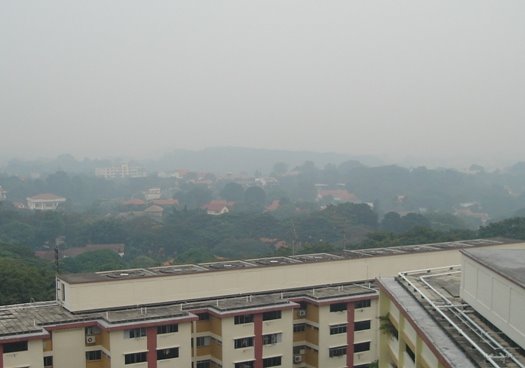
Visibility has dropped to only a few kilometres. Everywhere you go there is a strong smell of burnt ash.


Just contrast that photo with this one that I took in April. Bukit Timah (the hill in the middle) is completely obscured by haze.


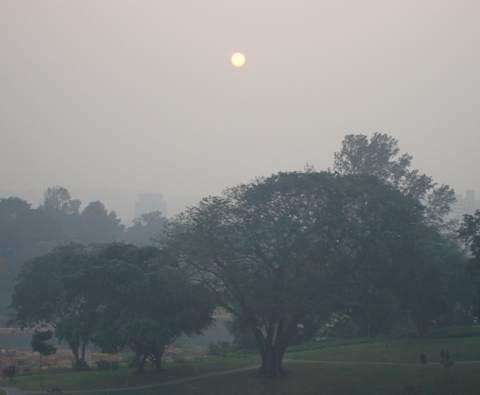
Thick haze is supposed to produce spectacularly red sunsets, but this haze is so bad that for most of the day I can't even find the sun. Shortly after I took this photo, the sun disappeared behind the haze again.

Argh.