Subscribe to Feed            Add to your Favourites

“It suddenly struck me that that tiny pea, pretty and blue, was the Earth. I put up my thumb and shut one eye, and my thumb blotted out the planet Earth. I didn't feel like a giant. I felt very, very small.” – Neil Armstrong (1930-2012)

Fresh Reads from the Science 'o sphere!

Tuesday, June 19, 2007

Real Virtuality Part II

Plato was an ancient Greek philosopher who wrote The Republic, a book of philosophical ideas and political theories.

One main idea in his book was the Allegory of the Cave.
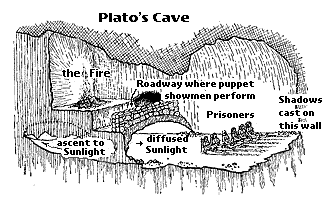


To explain this allegory simply, Plato believed that physical objects are not real.

They are analogous to the shadows of puppets that are cast on a wall, projected by a bright light.

The real causes of the shadows are the Forms (the actual puppets). Forms are Perfect and Eternal things. One quality they have in common is the Form of the Good (the bright light).

He believed that you cannot understand the essence of reality by studying the shadows, since shadows are temporary and unimportant things.

The only way to reach the truth is by reflection and divine contemplation.

Thus, it is pointless to study Nature by observations and performing experiments, since all you can learn will be meaningless details about "shadows".

Because Plato was such a influential philosopher, his ideas became the basis of spiritualistic worldviews that was to gain a strong foothold on social and political systems, even till today.

And helped to impede the progress of science for hundreds of years.

Heh.
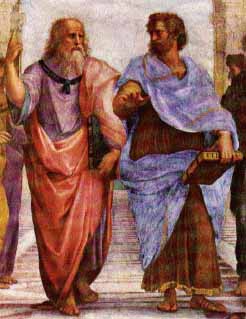


Plato (left) points to the Heavens while Aristotle (right) points to the Earth.

Lucky for us then that Aristotle came along. This wayward student of Plato was so opposed to some of his master's teachings that he was not appointed the head of Plato's Academy.

Instead of Eternal Forms, Aristotle believed that the ultimate reality is found in physical objects, and can be discovered by experience.

He had many interests - anatomy, astronomy, economics, embryology, geography, geology, meteorology, physics and zoology - and he studied these subjects by direct observations of Nature. Today we call this an empirical approach.

Though Aristotle had other wacky ideas and made some errors, his approach is much closer to the practice of modern science.

You're thinking: "Two dead philosophers. What's this got to do with the human predilection for virtual things?"

Well, it turns out that Plato might have a twisted idea of what constitutes reality, but his observation is partially correct.

Physical objects are real, of course, but the concept of "realness" doesn't exist unless you have a conscious mind to interprete them as such.

And for all his contributions to modern scientific thinking, Aristotle's assertion that the ultimate reality is in physical objects is partially wrong.

The "real" world we sense around us is actually a process produced by the interaction between our bodies and the physical world.

Our minds are already a type of virtual reality.

The mind is NOT merely an illusion. It feels so real that for centuries many people believed that the mind (or soul) exists in some transcendental realm, separate from our physical bodies.

We know this to be false because individuals with brain injury, or under the influence of certain drugs, or under situations of extreme stress and fatigue, perceive their world very differently from other people.

Humans tend to favour virtual things, because Life itself is a process - a real virtuality.

So, how did I arrive at this conclusion?

Stay tuned for Part III ("Emergence" of Gestalt and systems biology!) ...

Sunday, June 17, 2007

Real Virtuality Part I

Which one of these is a real image?

1. A photograph of you
2. Your reflection in a mirror

You are thinking: "HAH! That's simple secondary school physics. The photo is a REAL image. The reflection is a VIRTUAL image. Who doesn't know that?"

Yes, you're right.

But which image feels more real?

I mean, just look into a mirror.

It's YOU right there!

She moves! She breathes!

The "person in the mirror" feels so real that it is a common theme in numerous fantasy and horror stories.

Never mind the fact that it is merely a virtual image, a transient stream of photons that disappears the moment you walk away from the mirror. You can't hold it in your hand or keep it in your pocket.

What about a photograph then?

Well, a photo does have more permanence. It is printed on a physical medium, and you can store it for years.

So you can laugh at your nerdy fashion sense or cry at your loss of youthful beauty ten years down the road.

But even the highest resolution, most artfully taken photograph is still flat and lifeless compared to your image in a mirror.

It's a real image, but it doesn't feel as real as a virtual image.

Why?

And more importantly, why should ANYONE care???

Heh, I'll give you the straight goods.

$$$$


Fact: The MMOG (Massively Multiplayer Online Game) global market size has hit US$1 billion in 2006. Role-playing games such as World of Warcraft and virtual worlds such as Second Life are so popular that the market is projected to reach US$1.5 billion by 2011. Second Life may be a virtual world, but it has a real economy: nearly US$1.6 million dollars are traded daily within the game.

Fact: Actors who play doctors on TV earn more money than real doctors. Noah Wyle, who played Dr. John Carter on the TV show ER, earned an estimated US$9 million in 2004 - a staggering 45 times more than the average salary of actual ER doctors. As for actors who play doctors in the movies... let's not even go there.

Fact: "Alternative" medical practitioners can also make more money than real doctors. The US market for complementary and alternative medicine reached US$5 billion in 2005 and continues to grow. CDC reports that a whopping 74.6% of Americans used alternative medicine in 2005. Hugely popular products and services - which have little or no therapeutic effect when tested scientifically.

Fact: Motivational speakers and trainers make a tonne of money. In 2006, the total US market for "self-improvement" products and services climbed to US$9.6 billion. One example is the popular motivational speaker Deepak Chopra who often passes off diffuse and mangled nonsense as deep wisdom.

And...

Fact: The biggest personal fortune ever made in human history was built on the foundations of a "virtual" concept - software licensing. Bill Gates didn't make his billions of dollars building computers. He didn't even write the original code for the first MS-DOS. But yet he took only 30 years to amass a personal wealth of US$56 billion. In comparison it took Coca Cola more than one hundred years to reach a total worth of US$58 billion.

Now - do you see the importance of examining our peculiar human tendency to regard virtual things as more real than real?

Some kind of "Real Virtuality", if you will.

It makes cents, of course.

But it also makes sense.

Stay tuned for Part II (It's all Plato's fault!) ...

Friday, June 15, 2007

A Dead Horse And A Hot Babe

Only at Fresh Brainz will you find a photo of a dead horse next to hot babe.

Heh.

Of course you are asking: WHY???


Exhibit A: The skeleton of Eclipse, an 18th-century champion racehorse which was never beaten on the racetracks.

Exhibit B: Charlize Theron, uber hot babe and accomplished character actress.

Turns out that they have something very important in common.

They are both "average" individuals.

OK now you are going: WTF!?!!

Relax, I'm going to make this crystal clear in just a minute.

But first - a nice, big mystery for you.

If the hottest babes in the world are so rare, then why do so many people find them beautiful?

I mean stars couldn't become "stars" if only five people in the world thought they looked awesome, right?

It's true that people who look like Charlize Theron, Aishwarya Rai or Ayumi Hamasaki are hard to find. But so are people who are 90cm tall or people who weigh 500kg. Yet very few people would find such unique individuals attractive.

"Uniqueness" appears to be a popular catchphrase in society. There is a powerful, innate drive in human beings to distinguish ourselves from the crowd.

Yet despite the heroic efforts that people use to differentiate themselves from the thronging masses, little did they realize that nobody actually lives in Average Land.

It's like the place where the curve y = 1/x meets the y-axis or the point where parallel lines meet.

It doesn't exist.

There really isn't an average person who is 1.71m tall, earns $25 150.43 a year, drives 1.3 cars, keeps 0.7 cats and has 2.1 kids.

Maybe except in Novaya Zemlya.

The faceless average person is just a mental concept that we use to simplify the world and to separate the "me" from everyone else.

In reality, everyone is unique. We are all decidedly non-average in some physical or mental attribute.

Uniqueness is not something to aspire to - it's something you already are.

And it isn't something necessarily appealing neither. It's just... different.

As a matter of fact, when it comes to physical attractiveness, psychologists have proposed for a number of years that the "averaged" face is the most beautiful for most people.

An "averaged" face is a computer-generated model that morphs the average facial dimensions of a number of people into a single image.

Instead of becoming increasingly ho-hum as more faces are added into the database, the generated model actually becomes increasingly beautiful!

People with facial proportions nearer to that of an "averaged" face are considered attractive by far more people than people with "unique" faces.

More of a mass market appeal, as business types would say.

That's fine and dandy, but what's all this got to do with an undefeated racehorse?

Well, scientists want to find out what makes a champion racehorse gallop so fast.

So, they modelled Eclipse's skeleton on a computer and analyzed the movements of its reconstructed limbs.

Did Eclipse possess some incredible anatomical features that explained its speed?

Ultra-long, ultra-strong legs?

To their surprise, they discovered that Eclipse was average in almost every feature. Yet the combined effect of all these attributes resulted in a very speedy horse.

I know it sounds tad bizarre, but perhaps deep inside everyone really prefers to be "average", because that is the impossible ideal.


Would you like to know more?

-
Psychology of facial attractiveness
- Why was the racehorse Eclipse so good?

Tuesday, June 12, 2007

Four Buzzwords I Hate

What's that annoying buzzing sound that's flying around my head these days?

Is it mosquito?

Is it an electronic mosquito repellent?

Or is it the last, gasping hiss of the remains of an electronic mosquito repellant after I twack it repeatedly with a rubber chicken?

(It's supposed to be "ultrasonic", so why can I still hear its teeth-grinding, high-pitched shriek? WHY???)

No.

Fresh Brainz is deliriously happy to bring you the worst of the worst - Four Buzzwords That I Hate:

4. World-class

Singapore has many world-class features: a world-class airport, world-class convention centre, world-class art centre, world-class education system and world-class transport system.

But has anyone stopped to ask: where exactly is this place called "world"?

This magical place where there are four million smiles and perfectly pristine public toilets?

Is it in Reykjavik?

And why is "world-class" so similar in practice to "by American standards"?

If it actually means "by American standards", does it mean that we should aspire to have the calibre of their soccer teams, the artistic quality of their inner city graffiti, their unhindered freedom to walk around with automatic weapons, and the state of their current science education?

It if really means "by European standards", shouldn't we aim to build an endless stretch of nude beaches, open bakeries enhanced with all sorts of mind-expanding drugs, and manufacture cars that stop running once the temperature climbs above 30 degrees?

Wherever the "world" is, everyone wants to live there.

3. Bicultural

"Culture" is an easily misused word, since it has so many meanings. In biology for example, culture usually means the growth of bacteria or cells.

In daily usage, culture has two common meanings:

a. A high degree of taste and refinement formed by aesthetic and intellectual training.

b. These patterns, traits, and products considered as the expression of a particular period, class, community, or population.

Here in Singapore, at the intersection of the East and the West, a mysterious new buzzword has emerged to describe people who embody the best of both "worlds" (see above).

Bicultural.

Wait a sec.

If we are talking about the development of aesthetic taste in an individual, how can one person have two cultures - unless he is suffering from a split-personality disorder?

If we refer to the prevailing customs of the local population in Singapore, how can one person have two cultures in one country?

To matters worse, the exalted title of "bicultural" has been given to people who were born in some country, educated in another, just stepped into Singapore for two days... and suddenly they are bicultural Singaporeans!

They haven't even learnt how to order a dinosaur with extra Milo powder yet.

Oh my.

For me though, it's simple. Singapore may be strongly influenced by both the East and the West, but as a Singaporean, I only have one culture - Singaporean culture.

"Monocultural", if you like.

2. Self-radicalization

Comedian George Carlin once had this criticism for another ubiquitous buzzword "self-help":

If you could do it yourself... you didn't need help!

A similar problem here with the term "self-radicalization". Individuals who sought out extremist websites on the internet were not "self-radicalizing".

They were radicalized by somebody else. Through the internet.

Unless... they set up the websites themselves.

1. Passion

And the Ultimate buzzword that makes me throw up is - PASSION!

It's used so often and thrown around so indiscriminately that it has become a horrible cliché.

Passion at work... passion for science... passion for entrepreneurship... passion for success... passion passion passion...

Enough!!!

The biggest problem with this concept of passion - it is always after the fact.

If a person becomes successful, then she was "passionate" about her work.

If she failed, then she was obsessed. Or fanatical. Or obstinate. Or reckless.

Or even "not passionate enough" - whatever that means.

The language used to describe their efforts becomes completely opposite. Business analysts have observed this psychological bias for years.

Thus, I've decided that for me there are only two legit uses for the word "passion":

a. A type of fruit.

b. A hot night of wild lovin'.

Man do I have language issues this week.

Heh.

Any other buzzwords that get on your nerves?


Would you like to know more?

About misunderstood and abused words:
-
Most Misunderstood Terms In Biology
-
Most Abused Catchphrases In Science

About a nice, warm place where buzzwords deserve to go:
-
Buzzword Hell

Monday, June 11, 2007

Photo Gallery Two

Fresh Brainz is proud to bring you yet another collection of my favourite original photos.

Now with an even more whimsical edge!

Heh.


Escher's escalators
(2007) Sony DSC-S600


Evening lanterns
(2007) Sony DSC-S600


Jaws of death
(2007) Sony DSC-S600


Lightning strike
(2005) Yashica Electro 35 CC


Party of five
(2007) Sony DSC-S600


Pink streaks
(2007) Sony DSC-S600


Steel frame
(2007) Sony DSC-S600


Tunnel light II
(2007) Sony DSC-S600


Ultraviolet
(2007) Sony DSC-S600


Very old friends
(2007) Sony DSC-S600


What lies beneath
(2007) Sony DSC-S600


Would you like to know more?

About other photo collections:
- Fresh Brainz Photo Gallery One
- Sentient Puppets Photoblog

About the cameras I use:
- Sony DSC-S600 (6MP digital)
- Yashica Electro 35 CC (35mm-film rangefinder)

These photos are copyright © 2007 http://freshbrainz.blogspot.com