Subscribe to Feed            Add to your Favourites

“It suddenly struck me that that tiny pea, pretty and blue, was the Earth. I put up my thumb and shut one eye, and my thumb blotted out the planet Earth. I didn't feel like a giant. I felt very, very small.” – Neil Armstrong (1930-2012)

Fresh Reads from the Science 'o sphere!

Showing posts with label scisat. Show all posts

Saturday, April 17, 2010

Ash By Any Other Name Would NOT Smell As Sulphurous

The Eyjafjallajökull in Iceland must surely count as one of the most unpronounceable volcano names in the world.

Nonetheless, the effects of its latest eruption can be easily communicated.

Check out this satellite photo by NASA:


Iceland is outlined on the upper left of the photo, spewing what looks like atmospheric diarrhoea towards northern Europe on the lower right.

Volcanic ash clouds gradually spread over Europe causing numerous cancelled airline flights in... SINGAPORE?!??

That's right.

About 6,000 travellers at the Changi Airport have been affected by flight disruptions in Europe, many of them stranded at the transit lounges due to insufficient hotel rooms.

According to the Straits Times, about one in two travellers at Changi are transiting through Singapore to destinations in Europe or North America.

Also in that news report - an affected traveller Mr. Ken Jones said: "I am resigned to what is happening. It is nobody's fault, I guess, but of course I am annoyed and frustrated."

Understandably he is annoyed, but Mr. Jones may also add "relieved" to his mixture of emotions if he only knew what happens when a jet aeroplane flies through a plume of volcanic ash at 900 klicks an hour.

On the 24th of June 1982, passengers and crew of British Airways Flight 9 had the terrifying experience of just how that feels like:


Ah, the imprecision of the English language - volcanic "ash" sounds harmless enough, but it is not the same sort of "ash" that you get from burning paper or cigarettes.

Volcanic "ash" is actually made up of tiny, irregular pieces of rock and glass.

Oh my.


Would you like to know more?

More satellite photos of the Icelandic eruption:
- NASA Observes Ash Plume of Icelandic Volcano (NASA)

News of passengers stuck in Singapore:
- Stranded in Singapore (Straits Times)

Full video of the British Airways Flight 9 incident:
- Air Crash Investigation - British Airways Flight 9 (Google videos)

Another imprecision of the English language:
- Seven Years Of Science (Fresh Brainz)

Saturday, December 19, 2009

Counterintuitive Science: Fast Speed, Fat Shape

In popular science fiction, fast spaceships are often shown as streamlined, sharply-pointed vehicles: such as the X-wing in Star Wars or the Colonial Viper in Battlestar Galactica.

Sleekness has long been associated with speed, at least since the dawn of rocket science in the early 20th century.

This is hardly surprising because an aerodynamic shape is necessary to attain high speed on Earth, becoming increasingly important at speeds over 200 km per hour.

By the 1950s, human beings were on the verge of space travel, and the popular conception of a spaceship then (and even now!) for both professional engineers and the general public alike, was the sharp-nosed spaceplane.

A good example of this was the X-15 hypersonic research plane.


Striking resemblance to a you-know-what.

However, the reality that awaited spaceflight enthusiasts was somewhat less svelte...


How did needles turn into fat cones and bells?

It turns out that pointy-nosed spaceships perform well on their way out of the atmosphere, but not when they have to come BACK.

The re-entry speed of a vehicle coming in from low Earth orbit is about 27,000 km per hour (over 7 km per second!) or about 25 times the speed of sound.

Clearly, the vehicle has to lose a lot of speed in order to descend safely into the atmosphere, but how should this be done?

It is impractical for an Earth-launched spacecraft to reduce most of that speed using retro-rockets, since the large amount of fuel required becomes an additional burden to the launch vehicle.

So the returning vehicle must decelerate mainly by atmospheric friction using the atmosphere itself, and this is where the pointy-nose shape becomes a disadvantage.

At hypersonic speeds, a sharp object generates only a thin shockwave, allowing the intense heat of friction compression to come very close to the surface of the object contact the leading surface of the object. Thus, during early wind tunnel tests, the noses of the test vehicles simply melted away.

No known material could withstand such high temperatures.

However, when a blunt object is subjected to hypersonic speeds, due to much higher drag the air molecules ahead of the object cannot move away fast enough. A thicker shockwave forms, acting as a cushion of air that shields the leading surface from much of the intense heat, and lowering peak temperatures to within the limits that can be tolerated by existing materials.

Thus, only with the development of fat re-entry vehicles did human orbital spaceflight become a possibility.

Initially, Russian designers used a cannonball shape for their Vostok space capsule, which could safely re-enter the atmosphere in any orientation, but had a steep ballistic trajectory that was very harsh on the cosmonauts.

They later developed the "bell on a bowl" shape for their Soyuz, while US designers developed the "cone on a bowl" shape for their Mercury, Gemini and Apollo spacecraft. These shapes have a similar function - to provide some lift and self-righting ability, allowing the spacecraft to re-enter with a shallower and more comfortable trajectory.

For 20 years these fat and aesthetically displeasing spacecraft had the counterintuitive honour of being the fastest manned vehicles in history.

Not everyone was satisfied with this and there were numerous designs of spaceplanes (eg. Sänger, Hermes) to replace them, but most of them were unable to proceed beyond test phases.

Then, with the arrival of the US Space Shuttle (1981) and the Russian Buran (1988) the age of spaceplanes appeared to have finally arrived, though with their fat noses and thick bodies neither of them can really be considered sleek-looking. Unfortunately, Buran was cancelled after just one flight and the Space Shuttle is slated to be retired next year.

So for the foreseeable future at least, the vision of a sleek needle-shaped spacecraft stays bogged down in the realm of fantasy, while the cutting edge of real manned space exploration is delivered by the venerable, and fat, space capsule.


Would you like to know more?
- How the Spaceship Got Its Shape (Air & Space Magazine)

Saturday, March 14, 2009

Training Fresher Brainz!

When I completed my first vlog on the "History of the Pipette" over a year ago, I asked my sister, who is trained in the film production process, for some feedback.

She thought that it felt like a training video.

And lo and behold - it DID become a training video!

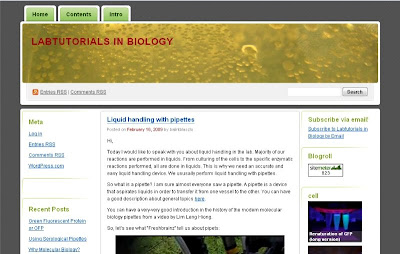
A new website called "Labtutorials in Biology" has featured my vlogumentary along with many other videos in one of their articles.

I think it's a great idea to have such a collection of video resources as an introduction to basic lab techniques for students and curious members of the public.


Why not pop over there for a quick look at their latest posts?

Saturday, January 31, 2009

Ponzi Scheme Maths

By now the US$50 billion Bernie Madoff scandal is pretty much old news, but like many other people I have been wondering how he was able to sustain his giant Ponzi scheme for over 20 years.

In stark contrast, good old Charles Ponzi himself could not even make his scheme last a year. He started taking in money from investors in early 1920 through his "Securities Exchange Company".

By July 1920 he had become a millionaire.

By November he was in jail.

Of course, no Ponzi scheme can last - there is no influx of funds from outsiders and the money just gets redistributed from new investors to existing investors. Since money is constantly drawn out of the system (especially the scam artist himself) the entire operation will collapse once recruitment starts slowing down.

However I wanted to get a feel for just how aggressive the recruitment will have to be in order to keep the scheme running, and I'm also curious about the difference in scale between Ponzi's operation and Madoff's.

So I hunted the Intertubes for a mathematical model of the Ponzi scheme, ideally an applet that allows you to plug in key variables such as the rate of return.

Unfortunately the models available on the Net either totally ignore the recruitment aspect (Bernie Madoff Calculator) or rely on difficult mathematics such as matrices and calculus.

Thus I have no choice but to work it out myself. I wish I could turn it into an automated applet, but my maths and programming skills are not good enough. If you are able to make that, please drop us a link.

Here's a simple, arithmetic model of the Ponzi Scheme:

1. Let's start with Charles Ponzi's version. He promised a 50% rate of return after an investment period of 45 days.

For the purposes of simplicity, let's restrict investment to one $1000 lot per person, synchronize their investment periods, and allow the investors to withdraw interest payments only at the end of each 45-day cycle.

My model is sort of a worst case scenario for Ponzi, in that he must have the capital to pay off the maximum potential interests due at the end of each cycle. (Note that if all the investors also demand their principal back, then the scheme would immediately end).

In reality he need not have so much cash at hand, since he can simply issue bogus profit statements to his investors and encourage them not to make withdrawals.

I also assume that Ponzi himself expects to make the same rate of return as his investors, which clearly isn't the case in real life.

Day 0

Ponzi starts the ball rolling with a capital of $1000.

He has to potentially pay himself $500 (0.5x1000) interest on Day 45.

If he doesn't withdraw his interest payments, it will accumulate to $1250[ (1.5x1.5x1000)-(1000)]on Day 90, which will make his cash flow negative $250 (1000-1250) and end his scheme.

So he must find another investor on Day 45.

Day 45

Ponzi plus one investor. Total capital = $2000

By Day 90 he has to potentially pay out (1250+500) = $1750
By Day 135 he has to potentially pay out (1.5x1.5x1.5x1000)-1000+1250) = $3635 (cash flow = negative $1635)

So he must find additional investors on Day 90.

Day 90

Four more investors. Total investors = 6. Total capital = $6000

By Day 135 he has to potentially pay out [2375+1250+(4x500)] = $5625
By Day 170 he has to potentially pay out [4062.5+2375+(4x1250)] = $11437.5 (cash flow = negative $5437.5)

Needs more investors again.

Day 135

11 more investors. Total investors = 17. Total capital = $17000

Day 180

Total investors = 52.

Day 225

Total investors = 155.

And so on...

As you can see, the number of investors required to sustain the scheme goes up exponentially.


This is due to the compound effect of the rate of return, which causes the capital to appreciate exponentially, as shown in the chart below.


50% return over 45 days actually represents a monstrous annual rate of return of 2563%!

This means that an initial investment of $1000 will grow to exceed a million dollars in only 2 years, an insane rate that is clearly impossible to sustain for long.

2. Now let's look at the figures for Madoff's version. Madoff promised a steady 12% return annually.

Year 0

Madoff also starts off with $1000.

By Year 1 he has to potentially pay himself $120
By Year 2 he needs $254.40
By Year 3 he needs $404.93
By Year 4 he needs $573.52
By Year 5 he needs $762.34
By Year 6 he needs $973.82
By Year 7 he needs $1210.68 (negative cash flow - scheme ends)

Needs to find an investor in Year 6.

Year 6

Madoff plus one investor. Total capital = $2000

By Year 7 he needs (1210.68+120) = $1330.68
By Year 8 he needs (1475.96+254.40) = $1730.36
By Year 9 he needs (1773.08+404.93) = $2178.01 (negative cash flow - scheme ends)

Needs another bloke.

Year 8

Total investors = 3. Total capital = $3000

By Year 9 he needs (1773.08+404.93+120) = $2298.01
By Year 10 he needs (2105.85+573.52+254.40) = $2933.77
By Year 11 he needs (2478.55+762.34+404.93) = $3645.82 (negative cash flow - scheme ends)

Add another bloke.

Year 10

Total investors = 4. Total capital = $4000

By Year 11 he needs (2478.55+762.34+404.93+120) = $3765.82
By Year 12 he needs (2895.98+973.82+573.52+254.40) = $4697.72 (negative cash flow - scheme ends)

Year 11

Total investors = 5.

Year 12

Total investors = 6.

And so on...

You can immediately see that there is much less pressure to recruit, especially during the early days of the scheme.

After five rounds of recruitment, Ponzi needed 154 more investors to keep going, whereas Madoff only needed five more.

In both cases, the money required to maintain the scheme is going up exponentially, but in the Madoff's version it is going up so slowly that the recruitment rate looks almost linear.


It would take many years before this increase is significant enough to be noticeable, which could be part of the reason why he remained undetected for so long.

Saturday, January 17, 2009

Science Buskers Festival

This morning, the finals of the first ever Science Buskers Festival was held at the Science Centre, so Fresh Brainz popped in to see some enthusiastic young people perform some interesting demonstrations and have lots of fun.


The MC came onstage and gave a brief intro about the competition. Each team was given five minutes for their presentation. He later explained that the teams would be assessed by three groups of people: audience voting (25%), the judges (50%) and online voting (25%).


The audience sitting in the central section gets to vote using one of these handheld devices.

But not everyone gets to vote, and Fresh Brainz as usual is unable to vote, as has been the case for the past ten years...

Just like real life!


The judges are VIPs from various institutions and they're there to give candid feedback to the teams after their presentation, American Idol-style.


Aside from giving the contestants points to ponder, they also award them actual points.

Unfortunately, Simon Cowell is not among them. As you may have heard, Cowell is now more famous than God.

So if you think that getting the Lord Almighty to make an appearance is difficult, just imagine how hard it is to get Cowell to grace this occasion.


As for the audience, they're there to push buttons on those voting remotes, and to cheer!

That's right, screechy screamy schoolgirl CHEER!

What's cool is that supporters not only cheer for their own team, but for other teams as well.


And audience voting results are instantly available after each team performance.

Now don't let that make you think that science is some sort of popularity contest...

Just like real life!

Here are some highlights of the presentations:


Explosions!


Bigger explosions!


... and an ethereal plume of nitrocellulose flame!

In addition to explosions, here comes another science demo mainstay...


Dry ice!


More dry ice!


Let's not forget bubbles induced by dry ice!


Larger bubbles!


... and a dancing robot?!??


A breakdancing robot, no less.

Overall, an interesting and ingenious assortment of demonstrations, but some of the teams can do better with a more coordinated and polished delivery. After all, science busking is more about busking than science, and busking is more about entertainment than education.

Forget the detailed explanatory charts - send in the LOX donuts!*

Nom nom nom nom... BOOM!


Would you like to know more?
- Videos of all the Science Busker team presentations


*Legal disclaimer: LOX donuts are dangerous. LOX donuts are not meant to be eaten. LOX donuts are not magically delicious and do not produce a strange tingling sensation on your tongue. Tongues which are injured by LOX donuts have to be removed quickly, efficiently and painfully at the Slack Tongue Clinic.

Saturday, September 13, 2008

Kids Science Fest!

The Kids Science Fest! event is part of the science.08 festival and is held at the Annexe Hall 2 of the Singapore Science Centre.

Admission to this carnival is free, so if you have kids who are interested, you can still head there for a fun time tomorrow.

What do they have in store for you? Fresh Brainz visited the Science Fest today and uncovered a flurry of activity!


Here, a cheerful demonstrator shows some children how to prepare mini-rockets using fizzy Redoxon tablets, water and empty film containers.

I tried to catch a photo of a rocket in flight, but they pop up really fast and I could only capture a faint spray of water and the foam they leave behind.

Rocket fuel - now in delicious blackcurrant flavour!


There are a few workshops for kids to do some hands-on experiments. This young man is playing with a bowl of cornstarch mixture, which is a type of non-Newtonian fluid.

Really odd stuff - if you treat it gently, it will flow like a liquid, but if you strike it hard, it will react like a solid.

Just like human beings!

Cornstarch can behave in bizarre ways when put under constant vibration. Check out this video that shows you how it can transform into a teeming mass of disgusting "alien fingers".


If you are not into wet stuff, here's a dry workshop for learning about electrical circuits and electronic components.


The theme of the carnival is about speed and reaction time, so here's a game to see how fast you can shoot hoops.


This slope lets children try out different combinations of weight and wheel size for the toy car to roll down at maximum speed.


The "Save the Marbles" game also uses an inclined plane - colourful marbles roll through a regular array of plastic pins randomly, and the player tries to catch as many falling marbles as possible using a sliding bucket.

Any player who manages to catch more than 30 marbles gets to sign her/his name on a "Board of Fame".

Neat.


Here they come!

*tik tik tik...*


In addition to workshops, there are also stage games - for the kids to participate in quizzes and maybe win a prize or two.


Looking a bit out of place is this small, dark alcove featuring some medical imaging panels.

There seems to be many MRI scans of brainz in here.

Which reminds me: it's time to catch the science show!


The "Think Quick!" science show is presented by Alan Gill and Bron Veale from Scitech in Perth, Australia.

Here's a huge brain prop sitting quietly in the foreground while Bron and Alan get ready for the show.

As a neurogeek, I am duty-bound to inform you that this brain is not anatomically accurate; the gyri are modelled haphazardly, it doesn't appear to have a temporal lobe and the cerebellum is too small.

I know you don't care.

*muack*


Alan starts off the show with an introduction about how we are all different, but our brainz work in a similar way.

Notice those balloons in the background? To test our reaction time, the audience has to clap twice whenever a balloon gets popped.

(To find out where some additional balloons are hidden, check out the previous photo).


For a science show it certainly has many elements of drama. The two presenters adopt an "odd couple" approach and engage in bickering and one-upmanship to entertain the audience.

Here are some of the highlights:


Alan offers to help Bron relax.

"First, let's measure your blood pressure!"


"And here's a balloon for you! Close your eyes and imagine yourself on an island... in the middle of an ocean... surrounded by palm trees..."


*sneak sneak...*


*POP!*

*Scream*

*clap-clap*

As you can see, this is not a relaxing science show.


In fact I think it is the most energetic science show I've seen so far. Here's Bron running around off-stage to demonstrate that an athlete must have a quick mind as well as a nimble body.


Next up - memory test!

How many faces can you remember?

"Who is this?"

Christopher Lee!

The presenters have adapted their show for the Singapore audience by putting up ten familiar local faces.


"Have you seen this man?"

Bet you didn't see that coming.


It turns out that people can only hold a small amount of information in their short-term memory - around seven items at a time.

Most people cannot remember all ten faces. I can only recall eight names now.


So how can you memorize huge amounts of information? Take for example the exact value of Pi, which is made of decimals that don't repeat and go on forever.

How to tackle such a large task?


Break it down into many small chunks, why of course!

I should mention that when I was in secondary school, the school invited some whiz-kid from the USA to "inspire" the students.

To demonstrate his intellectual superiority over the rest of us, he recited Pi to thirty-plus decimal places and we were expected to applaud and be in awe.

My fellow classmate snickered: "He could be making it all up. Who would know?"

Besides, what is the purpose of memorizing Pi? A party trick?

If you really want to impress - make a bizarre discovery, cure a disease or invent a longer lasting light bulb.


Now that we know the usefulness of chunking data, let's try the memory test again...

"Who is this?"

Brad Pitt!

Angelina Jolie!

Technically, Brangelina should be regarded as one functional unit.


Darth Vader!

Surprisingly there are many kids who are familiar with Star Wars characters - looks like the prequels have exacted a severe toll on the younger generation.

Larkin: "I look forward to working with you, Lord Vader".

Vader: "You're beautiful..."


Admiral: "Vader?"

Vader: "What?!?? Erm... I mean erm... destroying the rebel base will be a beautiful victory!"

Admiral: "Quite, Lord Vader. Please continue."

Vader: "What?!??"


Star Wars has been spoofed to death a thousand times over.


By chunking the faces into groups it becomes easier to remember them.

This kid in orange could recall eight names: "... plus that guy who looks like you."

Alan: "You mean Brad Pitt?"

Bron: "You don't look like Brad Pitt!"


More odd couple moments...


The presenters asked for two volunteers to help with their demonstrations.

Here, the children clap their hands once and Bron has to point towards the direction of the sound with her eyes closed.

So far so good.


Then Alan makes Bron wear this ridiculous looking rig that switches over the left and right direction of hearing.

Quite a struggle now...


It's time for Alan to perform his demonstration!

The young volunteer throws a tennis ball at Alan and he catches it with no difficulty.


In retaliation, Bron gets Alan to wear inverting glasses while trying to catch tennis balls.


Oops... it's impossible!

During one of the throws, the volunteer actually managed to hit Alan on the face with the ball.

*THUNK!*

Bullseye.


Finally, one more demonstration - the ability to read jumbled words, an observation that is often attributed to research conducted at Cambridge University.


A simple statement of truth?...


...of course they waste no time in resuming their fight...


And thus ends the show. I was ready to do some calping but I noticed that people were clapping, so I clapped instead.

Whew... luckily I was thinking fast!


After the show, Alan and Bron let some curious kids and parents try out their bizarre switcheroo gadgets.


Aside from the Kids Science Fest, I should also mention that there is a "Science of F1" exhibition in the Science Centre main building now. You'll need to pay the admission fee to enter the main building but if you haven't been inside for a while it's worth a visit (since the Dinosaurs are still around).


Here's an actual F1 racing car, on display for a limited time only. I like the speckled appearance of the carbon fibre wheel struts.


From behind you can see that the part of the car behind the driver tapers into a thin knife-edge.

Aerodynamics is critical when you are roaring along at over 300 km/h.


In keeping with the racing theme, a couple of FSAE racing cars from NUS are featured here.


Also on display is this fiery red Ferrari. Not sure why this is here, since it is a luxury sports car and not really a race car. Maybe it shares some technology with Ferrari F1 cars.


At around US$1,000,000 each it's not surprising that there are only two of them in Singapore.

I can never afford to buy one of these, nor do I want to.

Hmm... that suddenly reminds me of something!

A "vehicle" that I have which is also very rare and valuable.


The TIE/sa bomber.

Well, we were talking about Star Wars just now.

It's a vintage 1980 Kenner die-cast metal toy - apparently only 10,000 of these were ever made.

A mint-condition TIE bomber in its original packaging can fetch over US$1,000 in auctions. Well, I didn't buy this toy at age five just to NOT open the pack, so it won't be worth that much.

Still, it's a beauty.


Very few toys nowadays are made so detailed that they resemble movie props. Maybe that's a reason why these are so coveted.


As a parting shot, here's a close-up of the engines behind the bomber: not a 651-horse Berlinetta V12, but a pair of 125-KTU Sienar P-s4.

Roar.


Would you like to know more?

About a previous science.08 event:
-
Science in the Gardens
-
X-periment! 2008