Subscribe to Feed            Add to your Favourites

“It suddenly struck me that that tiny pea, pretty and blue, was the Earth. I put up my thumb and shut one eye, and my thumb blotted out the planet Earth. I didn't feel like a giant. I felt very, very small.” – Neil Armstrong (1930-2012)

Fresh Reads from the Science 'o sphere!

Tuesday, August 05, 2008

Smallest Snake In The World

When evolutionary biologist Blair Hedges went to Barbados in 2006, he found two tiny earthworm-like animals under a rock.

But they are not worms - actually he had discovered the smallest snakes in the world!


Prof. Hedges, who is a professor at Pennsylvania State University, noted that: "It's about as wide as a spaghetti noodle."

The newly found species, which has been named Leptotyphlops carlae after his wife, is only about 10 cm long when fully grown. It belongs to a genus of small snakes commonly called threadsnakes.

This discovery is significant because Leptotyphlops carlae may represent the lowest possible limit to the evolution of body size in snakes.

Large snakes tend to lay multiple eggs, and their offspring are about 10% of the adult length. On average each snake lays about seven eggs at a time (some species laying up to 100 eggs!)

In contrast, current evidence indicates that the Leptotyphlops carlae only produces one elongated egg in its body - it could be too small to produce any more. Offspring of threadsnakes are typically half the length of full-sized adults.

Having fewer offspring reduce the chances of survival to the next generation.

Prof. Hedges feels that the evolutionary tradeoff between the number and size of offspring has reached a size boundary in this species of snakes.

On the other hand, biologist Nathan Kley at Stony Brook University in New York, said it may be too soon to declare the Barbados thread snake the world's smallest, since several closely related species are only a few millimetres longer, and those species are known from only a few observations or museum specimens.

Prof. Hedges is aware of this.

"When you get down that small, every millimeter counts."

Sadly, the Leptotyphlops carlae may be on the verge of extinction. It appears to live on only a few square kilometers of forest on Barbados, where almost all the original forests have been cleared.

"I think it should be considered critically endangered because of its limited habitat, apparent rarity, and ongoing threats," Prof. Hedges added.


Would you like to know more?

About Leptotyphlops carlae:
- Original research article (PDF file): At the lower size limit in snakes: two new species of threadsnakes (Squamata: Leptotyphlopidae: Leptotyphlops) from the Lesser Antilles (Hedges 2008, Zootaxa)
- World's Smallest Snake Discovered, Study Says (National Geographic News)

About other animals that resemble worms:
- A squirmy jellyfish

Monday, August 04, 2008

Squandering The Future Away

If I have to pick one word to explain the main source behind social and economic power in human society it would be:
Credit

Sunday, August 03, 2008

Six And A Half Million

As the National Day approaches, it's a good time to look towards the future of our country.

The government is planning for a population size of 6.5 million people in about 40 years.

What's it like to live together with 6.5 million other people in a small island nation?

Here at Fresh Brainz, we are not content just with presenting numbers - we want to show you what having a population of 6.5 million people really means.

How much space does every person get?

The best way to visualize this is to use population density data.

Imagine a piece of land in Singapore that is exactly 1000 x 1000 metres in size.

That's one square kilometre.

Let's represent this area using an image file that's 1000 x 1000 pixels in size.

Inside this picture, we'll use one black pixel to represent one person.

For the ease of counting the people, let's ask them to stand close together in neat rows, similar to the marching contingents in the National Day Parade.

Back in 1961, the population density in Singapore was 2,540 people per sq km.

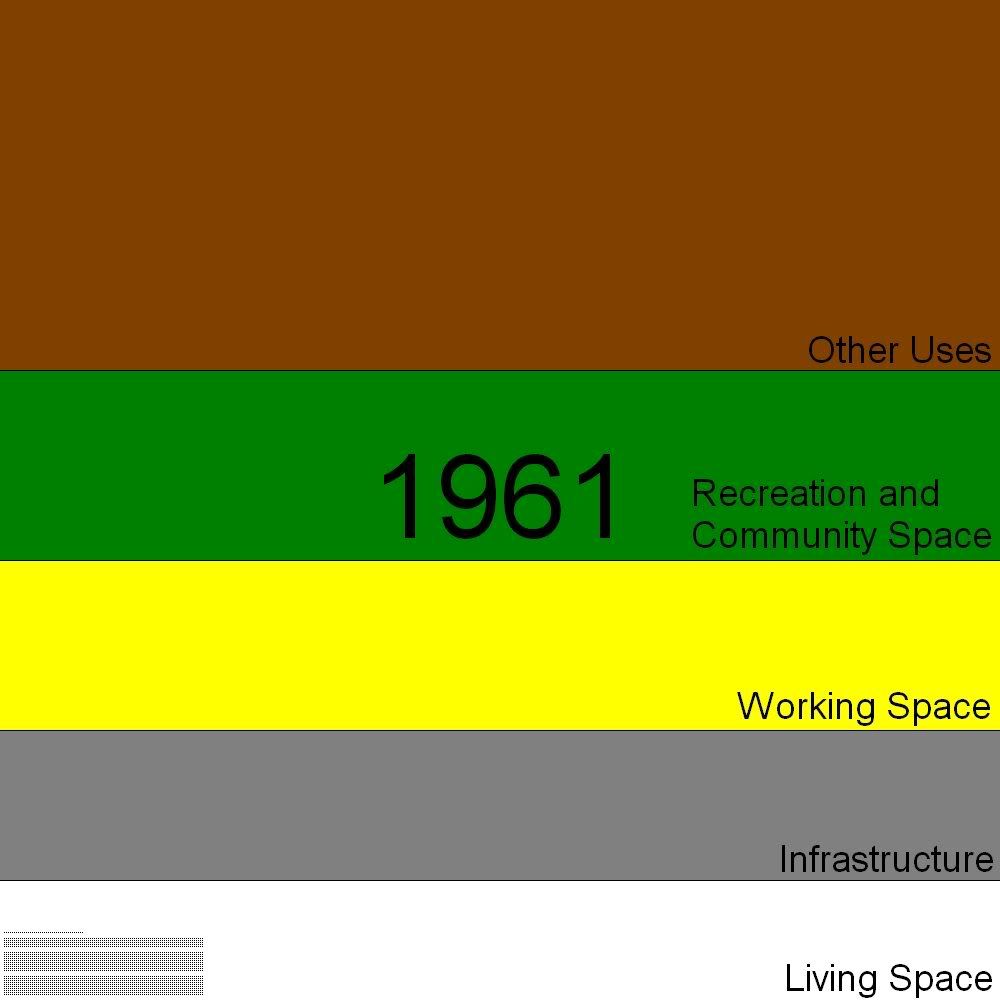
So, this was how the situation looked like (click picture for full size) :


Plenty of space isn't it?

Well, that isn't an accurate reflection of the actual living space that you'd get, because most of the land area in Singapore is not used for residential purposes.

I can't find a land allocation chart for 1961, so I used the Year 2000 data (PDF file) as a guide.

The various land uses are represented as coloured bars that take up proportionally correct amounts of space in our one square kilometre.

Only about 12% of the total area is allocated for housing, which is represented as a white bar at the bottom of the picture:


Clearly less space.

Still, you can see that our "pixel people" had enough room within the white bar to run around randomly and build single-storey homes to house their all tiny families.

Besides, there was also plenty of room for them to roam about in the other coloured bars, at work or at play.

Aww... all these happy peeps.


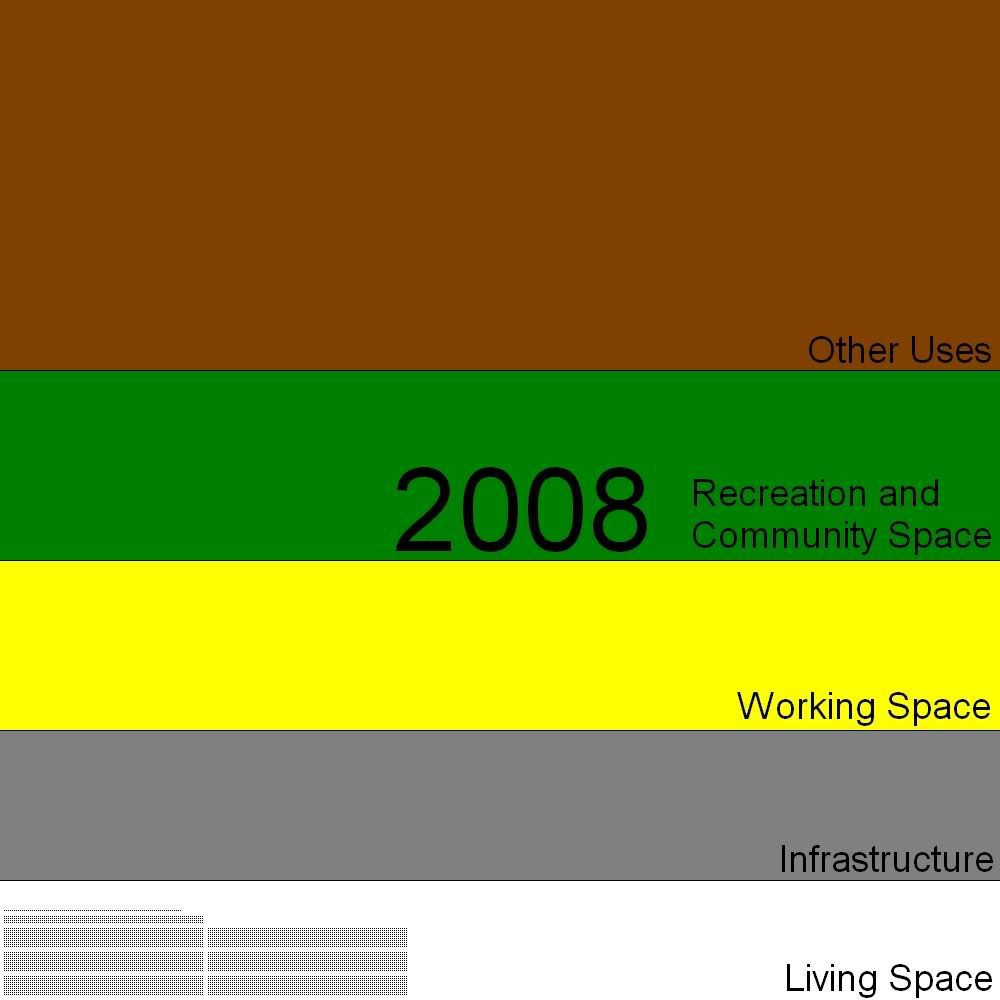
Today, our population density has shot up to 6,489 people per sq km.

At this point in time, we have the third highest population density in the world.

As you can see, even though they are standing fairly close together, the people themselves are already occupying a significant chunk of space for housing.

If we assume that a family of four lives in a four-room flat of 90 sq metres each, then the 120,000 sq m living space only has enough room for 5,333 individuals - less than the population density.

Thus, the only way out is up - it has become impossible to fit all of our people without high-rise housing.


Welcome to Singapore: population 6.5 million.

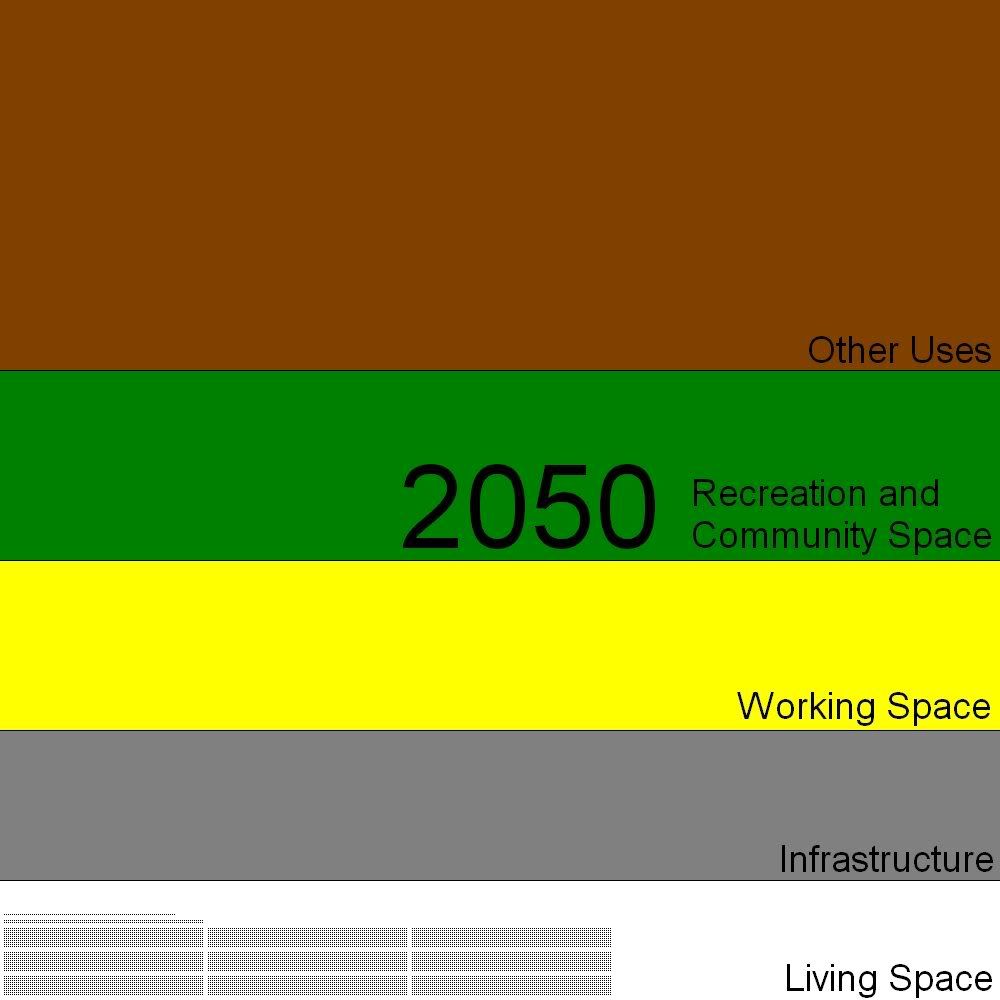
If there is no substantial increase in our land area and no change in land allocation patterns, then this is the situation in 2050.

With a population density of 9,286 people per sq km, standing room is starting to get scarce in the living space category. High-rise flats are an absolute necessity, and they will only get higher and higher.

Just imagine these people going to work in their 3-pixel long cars or 12-pixel long buses, filling up the space inside the grey bar.

Or how a weekend would look like when they go to the green bar for a picnic, or the yellow bar for a shopping spree.

Space would become very precious.

You are thinking: "Chay, not so bad what. If you spread out the little peeps throughout all the coloured bars, then there is still plenty of space to go around."

True... but it will still be much less space than 99.6% of the other countries in the world.

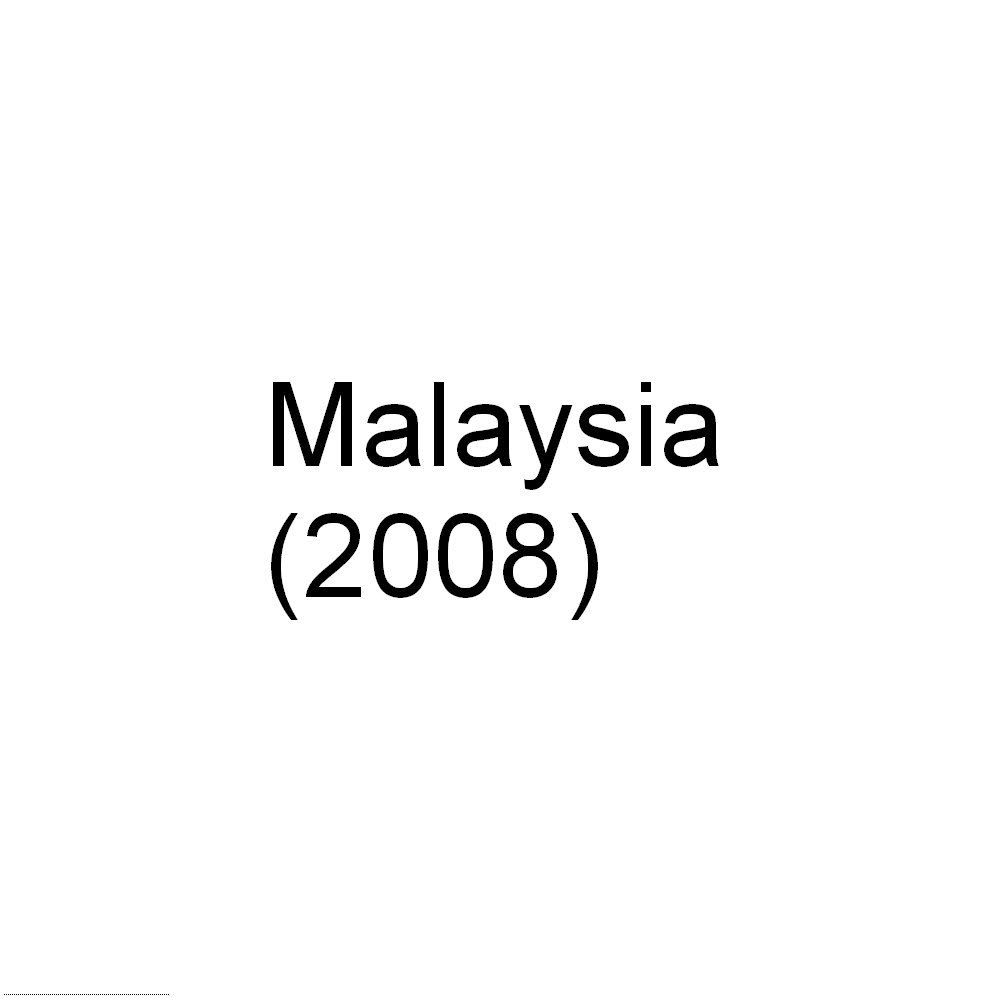
Just take any neighbouring country - say Malaysia, for example:


Can you even see the people in this picture?

Saturday, August 02, 2008

Sesame Street Gone Wild!

Here at Fresh Brainz, we sometimes worry about the unintended consequences of self-censorship...


I love Cookie Monster... I would *BLEEP* him.


Would you like to know more?

-
The Song of the Count

Friday, August 01, 2008

Seven Years Of Science

Today is sort of a special day for me, because exactly seven years ago, your humble narrator took his first fumbling steps into scientific research.

So far it has been... interesting.

I am aware that seven years' experience isn't much for a research career, but there are many young people who are just starting out and might like to have an idea of what doing science in Singapore is all about.

Instead of piling out stacks of boring details, I would like to illustrate my personal experience using one short, simple story.

It goes like this:

A long time ago, while studying in Canada, I went with a bunch of hostel mates to a dinner theatre.

It was the first time I had ever been to such an activity. You start with the dinner, which is a buffet-type spread, before the stage play begins.

While we were eating, one of the Canadian students pointed out a dish of wasabi next to a large plate of sushi.


Although I was familiar with sushi, I had never tasted wasabi before.

She said: "You're not going to like it - it's really hot."

Now that got me all worked up.

"Really hot?" I sneered.

Perhaps she had overlooked the simple fact that your humble narrator grew up in Singapore and had been thoroughly "trained" to eat some of the hottest and deadliest curries and chillies in the history of the Universe.

Why, I can chomp down one entire chilli padi directly without batting an eyelid, thank you very much.

Hot? HOT?!??

BWAHAHAHAHAHAHAR!

Weak-minded Canadians.

So I scooped up a big dollop of wasabi, plopped it onto my sushi and stuffed the whole thing into my mouth...

*FOOOOOOSH!*

The pain was immediate - a massive stinging explosion shot right up my nose, leaving me stunned in silence as tears slowly rolled down my cheeks.

Noticing my distressed expression, the concerned student asked:

"Are you OK? Is it hot?"

I weakly replied:

"Yeah... you're right... it is hot. I didn't know... wow... it is hot."

At that point in time, I wasn't struck as much by the inane imprecision of the English language as I was struck by the feeling of confusion and embarrassment.

How could I have felt so well-prepared, but still caught completely off-guard??!?

That, my dear readers, is what doing science feels like.